How Can CRSV be Prevented?
How CRSV can be prevented can be approached from different angles (which at times partly overlap), including by looking at key factors/routes to prevention; perpetrators; and preventing occurrence and preventing further impact (dual approach).
Some of the recommendations and ways to prevent CRSV committed by State militaries, rebel groups and militias concern:
1) Changing norms (e.g. responsibility rests with perpetrator; acceptance of victims in the community; empowering victims; intervene on time)
2) Creating safer spaces (e.g. patrolling, improved lighting, potable water)
3) Improving reporting (e.g. female police officers, protection in place)
4) Ending impunity: increase probability of punishment through trials
5) Assuring accountability, in particular for commanders
6) Mitigating sexual violence after conflict (e.g. sexual violence prevention programs)
In addition, applying a focussed “perpetrator approach”, may also help in preventing perpetrators committing CRSV, by having a(n):
1) Individual focus: Individual perpetrators and their backgrounds/personalities (sexual violence-prone individuals);
2) Group focus: Holding commanders responsible for CRSV committed by their soldiers (whereas killing can be legitimized in conflict, CRSV never is);
3) Cultural focus: Fostering military cultures in which perpetrators of CRSV are exposed and condemned (break though masculinity ideas).
Dual Approach: Preventing Occurrence and Preventing Further Impact
Furthermore, according to the UN report ‘Framework for the Prevention of CRSV’, it is helpful to look at the prevention of CRSV from a dual approach: 1) preventing the occurrence of CRSV; and 2) preventing further impact to a survivor or community once the violence has already occurred.
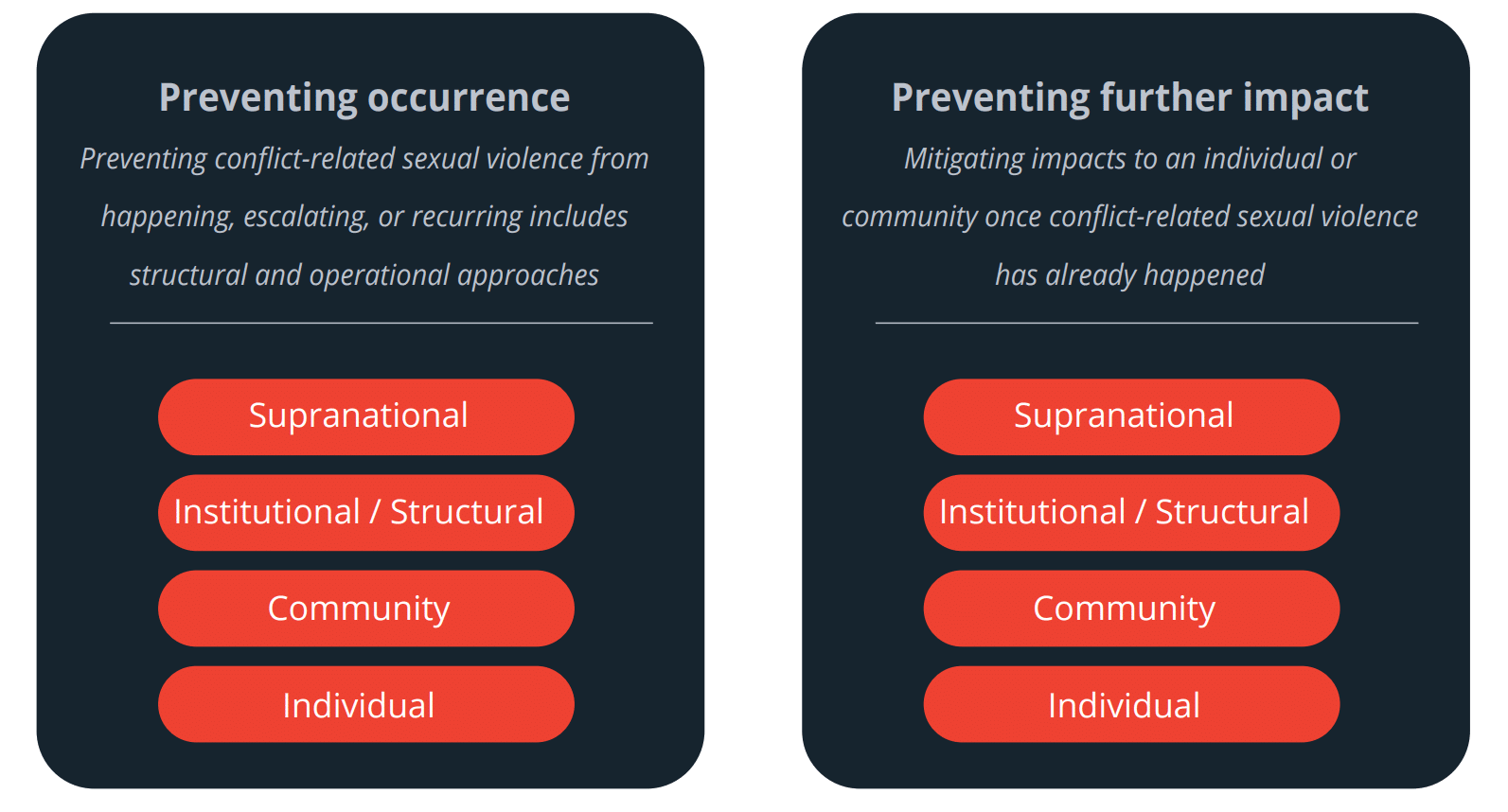
(Source: UN Action against Sexual Violence in Conflict: Stop Rape Now, Framework for the Prevention of Conflict-Related Sexual Violence, 2022, p. 19)
According to this report, “preventing the occurrence”, requires: “a.) building upon broader efforts to prevent conflict and atrocities, as well as gender inequality generally; b.) developing structural and operational approaches (such as strengthening social norms and rule of law and developing early warning systems indicators specifically focused on conflict-related sexual violence); c.) interventions tailored to diverse perpetrators and specific forms of conflict-related sexual violence; and d.) women’s meaningful engagement in peace processes, to increase chances of more durable and stable peace.”
“Preventing further impact”, on the other hand, refers to “the work of first line responders and service providers, who can mitigate the immediate impacts of violence through, inter alia, medical care, including sexual and reproductive health and mental health services; psychosocial support; care for children born of rape; safe shelter; and police protection. Efforts may also be longer-term in scope, focusing on peacebuilding and creating security in the community or society at large after violence has occurred. These measures might include peacebuilding or transitional justice efforts, including access to reparations.”
The report mentions that to prevent conflict-related sexual violence one must need to act at multiple, interacting levels: supranational (above or between States, at regional and international levels), institutional/structural (often by State entities, often on national level), community (often approaches of NGOs that address social dynamics and relationships, such as reducing gender inequality and stigma), and individual (focus on survivors and family members or perpetrators).

Sources ( a selection):
- Ragnhild Nordås, Preventing Conflict-Related Sexual Violence, PRIO Policy Brief, 02, 2013.
- Inger Skjelsbæk, Preventing Perpetrators: How To Go from Protection to Prevention of Sexual Violence in War?, PRIO Policy Brief, 03, 2013.
- UN Action against Sexual Violence in Conflict: Stop Rape Now, Framework for the Prevention of Conflict-Related Sexual Violence, 2022.
- Lindsay Stark, Kim Thuy Seelinger, Reine-Marcella Ibala, Yana Tovpeko, Denis Mukwege, “Prevention of Conflict-Related Sexual Violence in Ukraine and Globally”, The Lancet, Vol. 399, June 2022, 2173-2175.
- United Nations, Framework of Analysis for Atrocity Crimes: A Tool for Prevention, 2014.
- “Variation and Motivation of Perpetration” and “Root Causes and Contributing Factors of CRSV” in Theme “What is CRSV?”.
Assignment
How to Prevent CRSV?
- Read the articles of Nordås and Skjelsbæk (in “How can CRSV be prevented”) and explain in your own words what is meant with key factors/routes to prevention of CRSV and preventing perpetrators to commit CRSV.
- Read the ‘Framework for the Prevention of Conflict-Related Sexual Violence’ (in “How can CRSV be prevented”) and give – in your own words – 1-2 concrete examples of approaches for States and others to prevent the occurrence of CRSV on multiple levels (i.e. supranational, institutional/structural, community, and individual).
- Read the article by Stark and others (in “How can CRSV be prevented?). How can the “preventing further impact” approach (of the dual approach contained in the ‘Framework for the Prevention of Conflict-Related Sexual Violence’) be applied to the war in Ukraine?