Root Causes and Contributing Factors
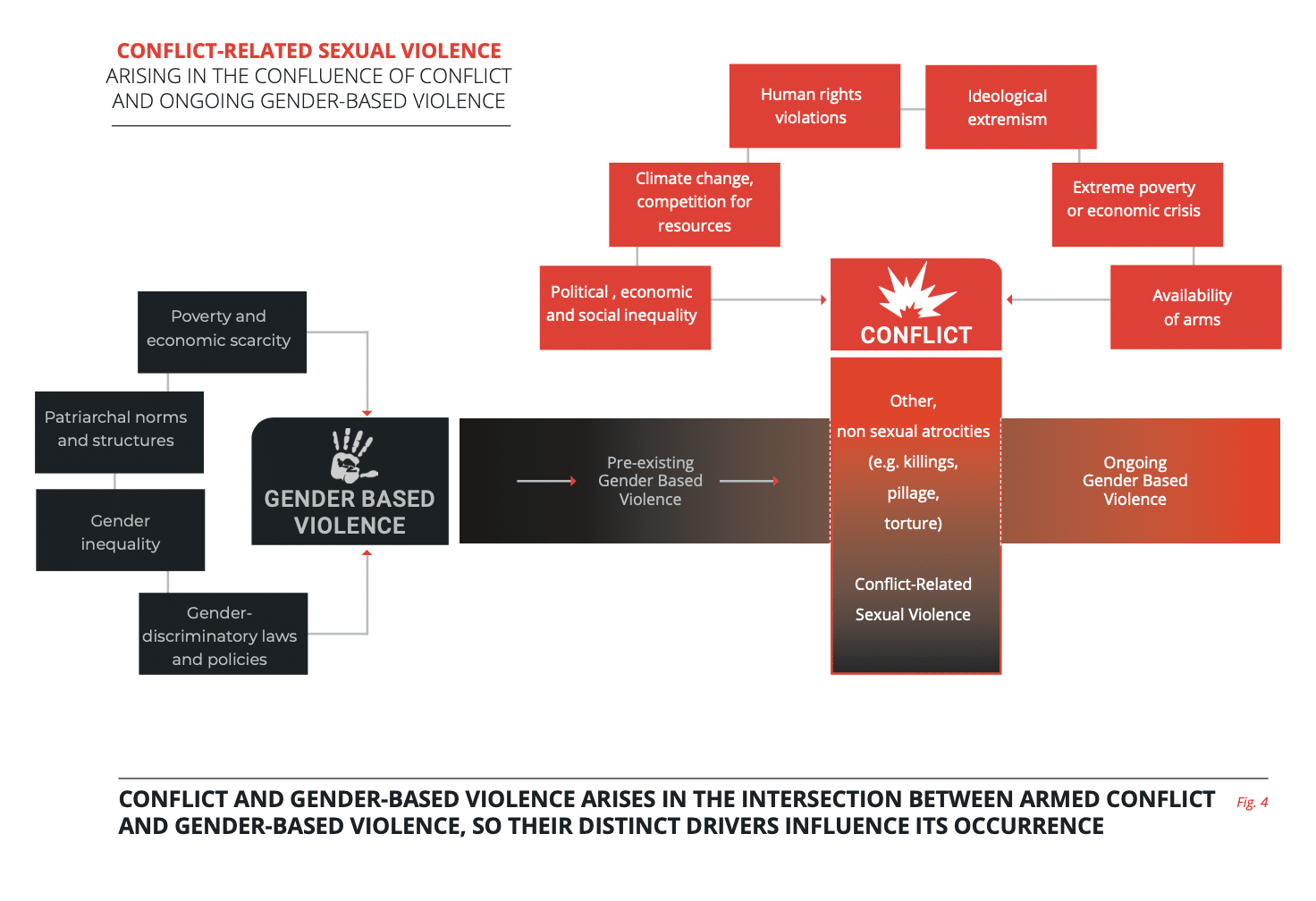
(Source: UN Action Against Sexual Violence in Conflict, Framework for the Prevention of Conflict-Related Sexual Violence, 2022, p. 13)
Conflict-related sexual violence is a complex form of violence arising from multiple, intersecting root causes and contributing factors, in particular:
(1) Conflict itself, driven by political, economic and social inequalities; human rights violations; extreme poverty or economic crisis; climate change; environmental degradation and competition for natural resources; ideological extremism; and availability of arms;
(2) Gender-based violence, driven by gender inequality, gender discriminatory laws and policies, patriarchal norms and structures, and poverty and economic scarcity.
Different characteristics or circumstances may increase individual or community risk of conflict-related sexual violence, such as:
- A person’s sex, gender identity, and subordinate position (e.g. women and girls of childbearing age, LGBTQI+ persons, detained persons).
- A person’s age (e.g. children and youth are vulnerable to forced recruitment).
- A person’s actual or presumed race, ethnicity, political opinion, or relationship to the enemy.
- Circumstances such as displacement or detention, the presence of occupying forces in a community, or increasing political or electoral violence, including targeted violence against women human rights defenders and political activists on social media and elsewhere.
It is important to look at this from an intersectional approach to understand how the multiple aspects of a person’s or community’s identity may give rise to compounded vulnerability and discrimination. For example, a girl of childbearing age in a particular ethnic group may be targeted for forced pregnancy in a context of ethnic cleansing or genocide.

Sources
- Dara Kay Cohen, “The Ties that Bind: How Armed Groups Use Violence to Create Social Cohesion”, Journal of Peace Research, Vol. 54, Issue 5 (September 2017), 701-714.
- Alon Margalit, “Still a Blind Spot: The Protection of LGBT Persons During Armed Conflict and Other Situations of Violence”, International Review of the Red Cross, Vol. 100, Issues 1-2-3 (2018), 237-265.
- Samuel Clowes Huneke, “The Duplicity of Tolerance: Lesbian Experiences in Nazi Berlin”, Journal of Contemporary History, Vol. 54, Issue 1 (2019), 30-59.
- Lindsay Stark, Ilana Seff and Chen Reis, “Gender-based Violence Against Adolescent Girls in Humanitarian Settings: A Review of the Evidence”, Lancet Child & Adolescent Health, Vol. 5, Issue 3 (2021), 210-222.
- Maureen Murphy and others, “Socioecological Framework for Drivers of Conflict and Postconflict Violence Against Women and Girls”, Violence Against Women, Vol. 29, Issue 2 (2022), 406-427.