Scale of CRSV
CRSV is not limited to one geographic region; rather CRSV has been reported in almost every region of the world. CRSV committed on a massive scale constitutes a serious problem and a threat to international peace and security. In one study (conducted by Cohen in 2013), high or very high levels of civil war-related sexual violence were reported in nearly every region of the globe between 1980 and 2009. For example, in Bosnia in the war of 1992-1995, it has been estimated that 20,000 – 50,000 women and girls experienced sexual violence. Although sub-Saharan Africa experienced the most civil conflict during this study period, only 36 percent (ten of twenty-eight) of wars in this region showed evidence of the highest level of CRSV. In eastern Europe, however, the highest level of CRSV was reported in 44 percent (four of nine) of conflicts during this study period.
Each year, the UN Special Representative on Sexual Violence in Conflict publishes a report with the latest coverage of countries that are in a state of conflict and in which CRSV takes place, including a list with parties credibly suspected of committing or being responsible for CRSV. Although exact numbers of victims/survivors of CRSV remain difficult to track down, for an overview of countries in which CRSV has taken place (with estimates of number of victims and the different perpetrator groups involved), read also the chapter “Sexual Violence in Conflicts around the World” in the book “And I Live On (2019)”.
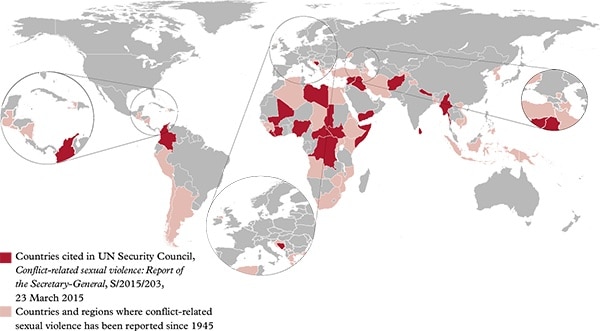
(Source: UK Parliament, House of Lords, Sexual Violence in Conflict: A War Crime, 2016)
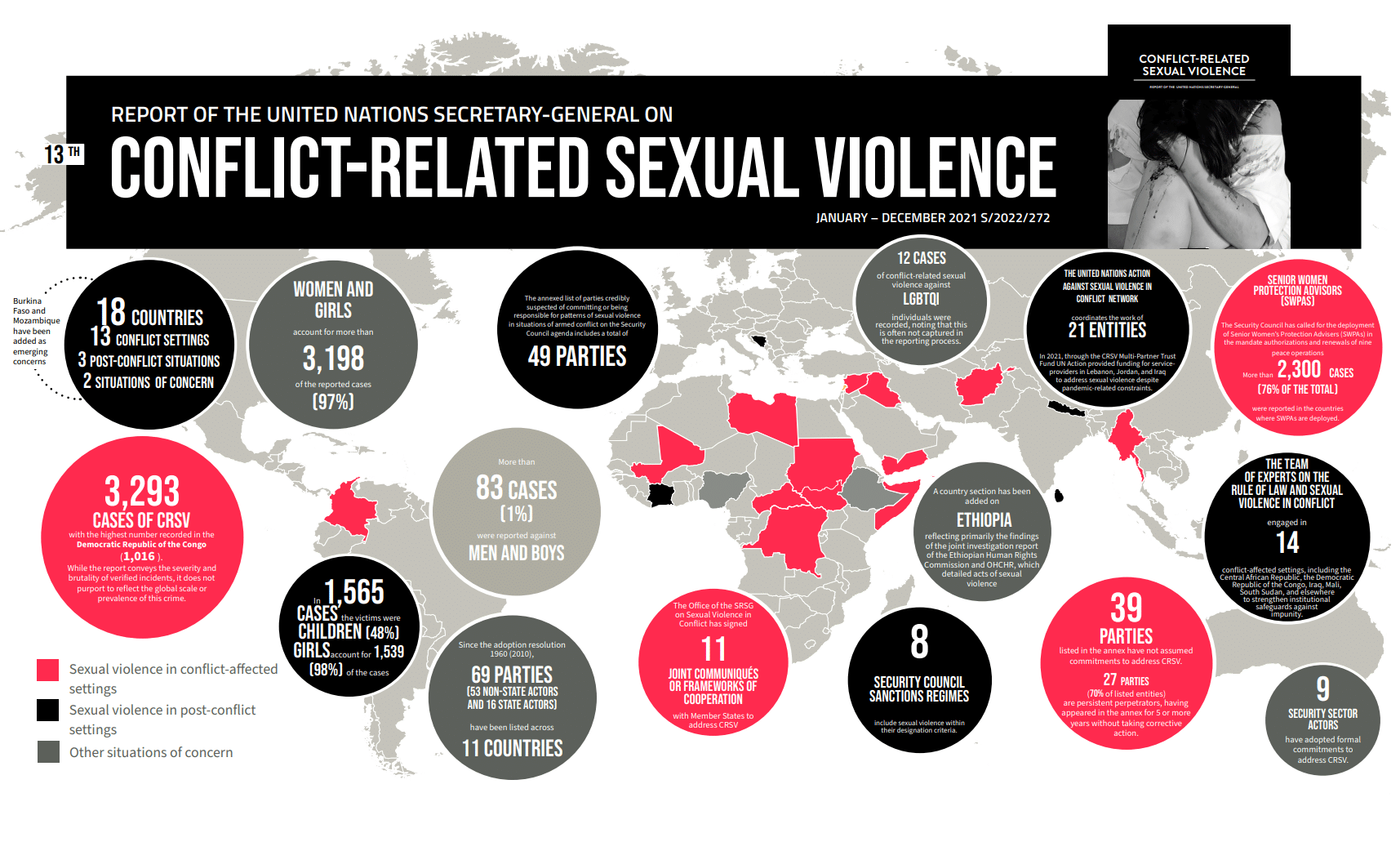
(Source: UN Secretary-General on Conflict-Related Sexual Violence, 2021)
Forms and Nature of CRSV
The manifestation in which CRSV takes place varies per conflict and perpetrator (group), and may include:
• Rape
• Gang rape
• Sexual slavery
• Enforced sterilization
• Forced incest
• Forced marriage
• Mutilation of victims’ breasts, babies in wombs, vaginas, penises
• Penetration with objects
• Forced nudity
• Forced masturbation
• Forced sex with dead animals
Victims may experience CRSV at one given time, for a longer consecutive period of time, or even at different times at different places during the conflict, by one or several perpetrators. The brutality of CRSV is staggering.
Impact of CRSV
The impact of CRSV is immense, on the individual, family, community, national and international levels. The suffering inflicted is long lasting, even long after hostilities have ended (e.g. women may even die years after the conflict has ended due to the so-called “secondary diseases” they have developed as a result of the CRSV, such as TBC and cancer). Furthermore, CRSV often provokes multiple, cumulative trauma as survivors have experienced a range of CRSV as well as other crimes (e.g. loss of family members, property) during the conflict.
CRSV can result in physical and psychological trauma, including HIV-infection and sometimes death. It can result in social isolation, stigma and ongoing victimization, as survivors may be cast out by their families and communities (e.g. because they became pregnant with the baby of the perpetrator belonging to the enemy group), as if they were to blame as to what was forced upon them. CRSV often also has an economic impact, as survivors may not be able to work anymore due to the physical and psychological trauma and/or the poverty situation they live in due to the situation the conflict has brought them into. Survivors often do not report the crime (e.g. due to a not functioning (corrupt) law enforcement system, fear of reprisals, or not being believed) and rarely receive justice.
CRSV therefore destroys individuals, families and communities and lays those impacted by it open to further harms. United Nations Security Council Resolution 1888 (2009) recognized that CRSV, when used or commissioned as a tactic of war in order to deliberately target civilians or as part of a widespread or systematic attack against civilian populations, is furthermore a threat to international peace and security, and that steps are needed in order to prevent and deter future violations.
Children Born from CRSV
Watch the documentary “Intended Consequences” and the stories in “Disclosure” made and written down by Jonathan Torgovnik about the women who were raped during the Genocide against the Tutsi in Rwanda in 1994 and as a result became pregnant and had children from the perpetrators:
Intended Consequences (2008)
In 1994, in the East African nation of Rwanda, one million ethnic Tutsi people were slaughtered, in a genocide committed by their Hutu countrymen. But the scars left by these murderous militiamen go well beyond the numbers of the dead: they live on, in the lives of the women they held captive, raped – and left pregnant.
Intended Consequences tells the stories of some of these women, victims of the sexual violence used as a weapon of war against them, i.e. sexual violence as genocide. Some 20,000 children were born as a result. Photojournalist Jonathan Torgovnik photographed and interviewed 30 women and their families, and has produced a piece of incredible complexity: how does a woman care for her child when it’s the son or daughter of the man who raped her?
(Source: Mediastorm, Intended Consequences, 2008)
Disclosure (2019)
Ten years later, Disclosure follows the women whose stories were told in Intended Consequences and continues to shed light on the underreported issue of genocidal rape, and its consequences: the children born of rape in conflict areas and the complex and deep trauma they live with for generations. The testimonies embody stories of hope, forgiveness, fragility, and a strong undertone of the lingering struggles associated with severe trauma and effects of genocide.

Sources
- Dara Kay Cohen, “Explaining Rape during Civil War: Cross-National Evidence (1880–2009)”, American Political Science Review, Vol. 107, Issue 3 (August 2013).
- Dara Kay Cohen, Amelia Hoover Green and Elisabeth Jean Wood, Wartime Sexual Violence: Misconceptions, Implications, and Ways Forward, United States Institute of Peace, Special Report, 2013.
- UN Secretary-General, Conflict-Related Sexual Violence: Report of the United Nations Secretary-General, 29 March 2022.
- Sexual Violence in Armed Conflict Dataset (1989-2019).
- Office of the Special Representative of the Secretary-General on Sexual Violence in Conflict, In Their Own Words: Voices of Survivors of Conflict-Related Sexual Violence, 2021.
- Anne-Marie de Brouwer, Sandra Ka Hon Chu, Eefje de Volder and Samer Muscati, And I Live On: The Resilience of Rwandan Genocide Survivors of Sexual Violence (Wolf Legal Publishers, 2019).
- Women’s Initiative for Gender Justice, The Hague Principles on Sexual Violence, 2020.
- International Federation for Human Rights (FIDH), Sexual and Gender-based Violence: A Glossary from A to Z, 2020.