Thematic Issue: UN Peacekeeping Forces
The Security Council has mandated United Nations field missions to prevent and respond to CRSV. Missions are expected to prevent and respond to CRSV based on their human rights, child protection, protection of civilians, women, peace and security, and wider prevention responsibilities. At the moment there are four peacekeeping missions that have a specific Security Council mandate to address CRSV: i.e. MINUSCA in the Central African Republic, MINUSMA in Mali, MONUSCO in the Democratic Republic of the Congo, and UNMISS in South Sudan.
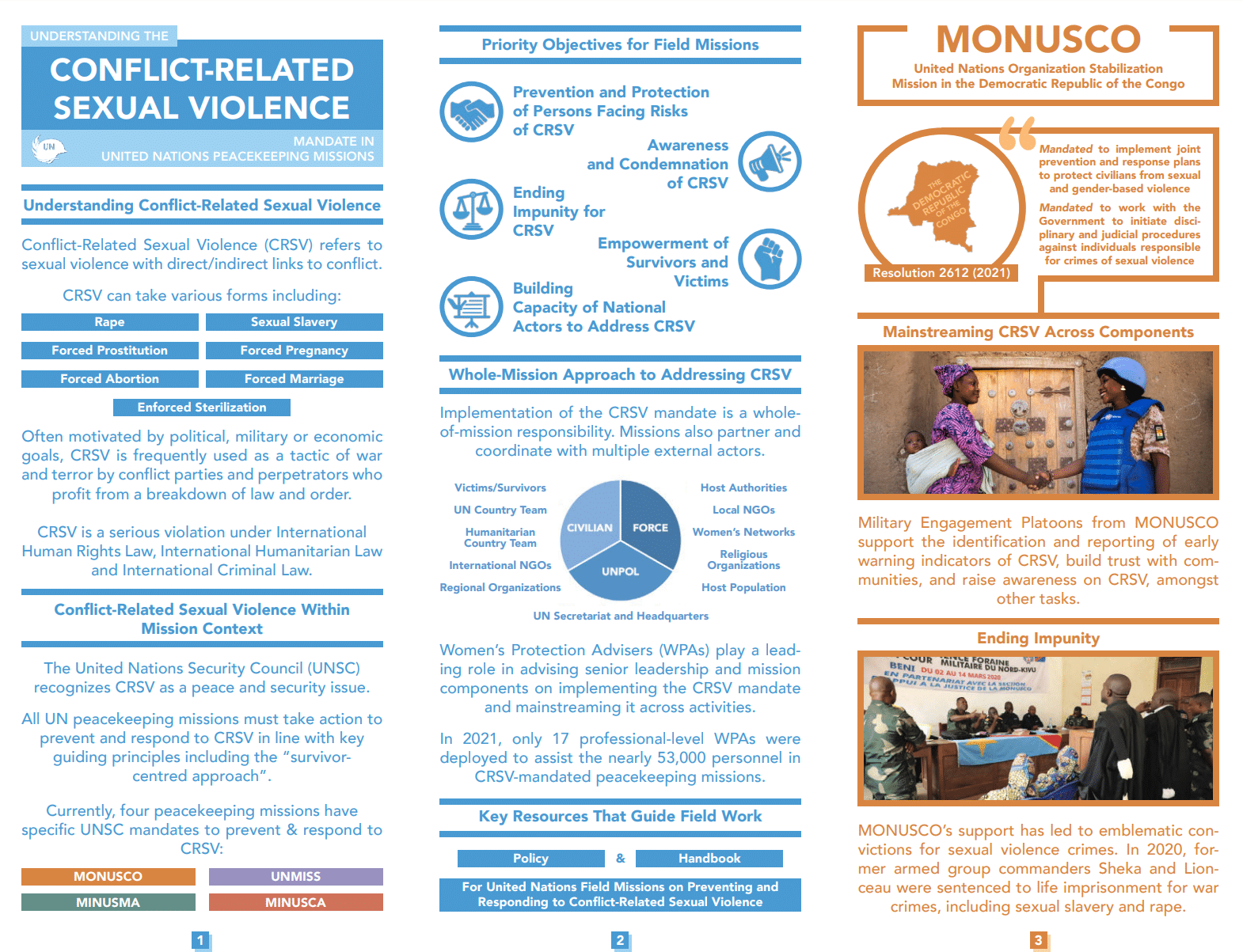
(Source: UN Peacekeeping, Leaflet: Understanding the Conflict-Related Sexual Violence Mandate in UN Peacekeeping Missions)
This short film shows how MONUSCO and its partners are working to prevent and respond to CRSV in the DRC:
According to UN Peacekeeping:
“CRSV is a crosscutting issue that requires engagement from multiple actors: host countries, the United Nations Country and Humanitarian Teams (UNCT/HCT), non-governmental organizations and civil society organizations. Under overall guidance the Head of Mission, each of the components and sections of peacekeeping missions contribute to prevent and respond to CRSV with their respective and complementary capacities. A coordinated and comprehensive approach across civilian, military and police components, from strategic to operational levels, is critical for peacekeeping missions to effectively prevent and respond to CRSV, while fulfilling their mandate to promote and maintain international peace and security.
Peace operations carry out a wide range of multi-disciplinary work to prevent and respond to CRSV.
Mainstreaming CRSV within the mission
Preventing and responding to CRSV is a mission-wide responsibility and all [the] teams must integrate CRSV concerns at the strategic, operational and tactical levels, and across all functions.
Monitoring and Reporting
[They] document trends and patterns of CRSV and contribute to reports to the Security Council, which not only exerts pressure on armed forces and groups responsible for CRSV, but also informs response and preventive actions at mission-level.
Physical Protection
[Their] missions map areas where civilians are most at risk of CRSV and deploy forces to prevent, deter and stop violations while supporting the provision of assistance to affected survivors.
Negotiating with parties to conflict
[Their] missions engage in dialogues with parties to conflict to elicit commitments to end CRSV. [They] then accompany these parties in developing and implementing Actions Plans to prevent violations and ensure accountability for perpetrators.
Advocacy
The senior leadership of [their] missions use good offices and advocacy to address CRSV from a political perspective with the host State and with parties to the conflict. This includes ensuring that CRSV is addressed throughout all stages of mediation efforts, ceasefire, and peace agreements.
Awareness Raising
Through radio messages, events and campaigns, [they] raise society’s awareness of CRSV at all levels and aim to change attitudes that normalize CRSV in order to prevent future acts of sexual violence and end the stigma too-often borne by survivors.
Capacity building
[Their] missions work with a wide range of national counterparts, including authorities and civil society organizations, to strengthen their ability to deal with CRSV concerns through activities like training programmes and technical assistance.
Ending impunity
With the goal to end impunity for CRSV, [they] support national investigations and prosecutions for sexual violence crimes and promote the safe participation of victims and witnesses in judicial processes. [They] also advocate the adoption of strong national legal and policy frameworks on sexual violence and remedies for survivors.
Training
Mission-wide training on CRSV is provided so that every civilian, military and police peacekeeper has the knowledge and skills to prevent and respond to CRSV while ensuring a survivor-centred approach.”
The work of UN Peacekeepers is guided by the UN Policy for Field Missions on Preventing and Responding to CRSV. Those principles include: Do no harm; Confidentiality; Informed consent; Gender-sensitivity; the Survivor-centred approach; and the Best interest of the child. In addition, the work is guided by the Handbook for United Nations Field Missions on Preventing and Responding to Conflict-Related Sexual Violence. The Handbook aims to provide practical guidance to civilian, military and police components of field missions and increase their capacities to prevent and respond to CRSV.
Watch this animated film about how UN Peacekeeping aims to place survivors at the center of conflict-related sexual violence response and prevention:
Unfortunately, UN Peacekeeping forces have been involved in committing sexual exploitation and abuse (SEA) against the local population themselves while on mission. The UN has, following several such incidents, now a Zero Tolerance Policy when it comes to SEA as it threatens the lives of people the UN are to serve and protect and it also undermines discipline, and damages the reputation of the United Nations.
It is therefore strictly prohibited to have any sexual activity with anyone under the age of 18 years (regardless of the age of majority or age of consent locally or in their home country). Mistaken belief as to the age of the person is no excuse. It is strictly prohibited to have sex with anyone, in exchange for money, employment, preferential treatment, goods or services, whether or not prostitution is legal in their own country or the host country. It is strictly prohibited to engage in any other form of sexually humiliating, degrading or exploitative behaviour. Involvement in any act of SEA will be investigated and prosecuted if warranted. Any proven act of SEA will result in measures that can include but are not limited to: suspension, immediate repatriation, dismissal, imprisonment and a ban from future United Nations employment. UN personnel is trained on the topic of SEA and how to prevent and address it.

Sources ( a selection):
- Esther Bootsma, Patrick Cammaert, Don’t Look the Other Way!: Lessons in Leadership from a Dutch UN General, October 2020 (also available in Dutch ‘Kijk niet weg!’, both hard copy and E-book).
- United Nations, Handbook for United Nations Field Missions on Preventing and Responding to Conflict-Related Sexual Violence, 2020.
- United Nations, United Nations Field Missions: Preventing and responding to Conflict-Related Sexual Violence, January 2022.
- CRSV Team, Department of Peace Operations, 2021 Annual Summaries of Activities and Good Practices in Preventing and Responding to Conflict-Related Sexual Violence by United Nations Peacekeeping Missions, June 2022.
- UN Women and the Department of Peacekeeping Operations (DPKO), Addressing Conflict-Related Sexual Violence An Analytical Inventory of Peacekeeping Practice, 2010.
- UN Action, Matrix: Early-Warning Indicators of Conflict-Related Sexual Violence, 2011.
- Louise Olsson, Angela Muvumba Sellström, Stephen Moncrief, Elisabeth Jean Wood, Karin Johansson, Walter Lotze, Chiara Ruffa, Amelia Hoover Green, Ann Kristin Sjöberg and Roudabeh Kishi, “Peacekeeping Prevention: Strengthening Efforts to Preempt Conflict-Related Sexual Violence”, International Peacekeeping, Vol. 27, Issue 4 (2020), 517-585.
- UN Peacekeeping, Military Aide Memoire: United Nations Measures against Sexual Exploitation and Abuse: Commanders’ Guide on Measures to Combat Sexual Exploitation and Abuse in United Nations Military, October 2017.
- Anne-Marie de Brouwer, “Sexual Abuse and Exploitation by UN Peacekeepers”, in: Terry Gill et al. (eds.), Manual on Military Law, 2017.
- NATO, NATO Policy on Preventing and Responding to Conflict-Related Sexual Violence, 31 May 2021.
Assignment 1
UN Peacekeeping Mission
(1) Study one UN Peacekeeping mission and explain what they have achieved in preventing and addressing CRSV and what the challenges are.
(2) Explain what the Zero Tolerance Policy of the UN entails when it comes to UN personnel being themselves involved in committing SEA. In addition, to what extent do the rules and regulations on preventing and addressing SEA work in practice?
Assignment 2
UN Peacekeeping: Case Scenario (DRC)
Background:
The Democratic Republic of the Congo (DRC) is one of the largest countries in Africa – roughly the size of Western Europe – and has been plagued by civil war and insecurity for more than a decade. The long conflict has been characterized by the fight over natural resources, the meddling by neighboring countries, and, not least, its toll on the civilian population, including the prevalence of sexual violence.
Since 2000, a multi-dimensional UN peacekeeping operation (now called MONUSCO) has been deployed to DRC, focusing on the eastern and most unstable part of the country. In addition to its civilian leadership and civilian and police components, MONUSCO consists of a close to 20,000-strong military component organized in brigade-size formations, with weaponry ranging from small personal arms to attack helicopters. A large number of utility helicopters are also available. The brigades are deployed in the eastern provinces of North and South Kivu, Province Orientale and Katanga, including a number of permanent bases (approximately 150 soldiers) as well as mobile operating bases (MOB) of approximately 50 soldiers each.
Eastern DRC is rich in minerals and covered with jungle and patches of grazing land. Foreign-armed groups and local rebels prey on the local population. State authorities have a weak or non-existent presence in many rural areas, and police are poorly trained, equipped and frequently not paid. The Congolese Army (FARDC) includes many ex-combatants from various rebel groups, and is struggling to provide sufficient training, equipment, discipline and leadership. Several commanders have economic ties to external groups, and members of the FARDC are frequently found to be the perpetrators of atrocities committed against the civilian population.
In this context, the rates of rape, killing, and property destruction endured by civilians are far higher than the number of military casualties since the beginning of the conflict since the nineties. In particular, sexual violence directly or indirectly caused by the conflict has become one of the greatest threats to the security of civilians and a clear impediment to peace building and the success of peace operations. This is manifest in the use of sexual violence as a tactic of war against populations, the majority of whom are women and girls in contested territory; as part of widespread or systematic attacks against civilians; as part of patterns of predatory attacks against civilians in and around refugee and internally displaced persons camps; in connection with the illicit exploitation of natural resources; as an incentive for irregularly paid combatants; at checkpoints manned by abusive elements of the national army FARDC; perpetrated by former combatants reinserted into communities through the disarmament, demobilization, and reintegration (DDR) process; and by the ‘normalization’ amongst civilians of brutal forms of violence described as virtually unknown before the conflict, such as gang rapes, public rapes, forced incest and the rape of victims of all ages, from infants to elderly people. Sexual violence is also used as a form of punishment against populations and includes the rape of men and boys. Apart from the physical and mental consequences, a sexual survivor often faces a future of indigence and social exclusion for herself and her children. Most lose their health, livelihoods, husbands, families, and support networks, which in turn shatter the structures that anchor community values.
MONUSCO has a mandate to assist the DRC government in strengthening its military capacity, not least through the training of and jointly planned operations with the FARDC. At the same time, the Mission’s primary task is to ensure the effective protection of civilians under imminent threat of physical violence, including all forms of sexual and gender-based violence and the empowerment of women. Since members of the FARDC are responsible for acts of violence against civilians, MONUSCO often finds itself in a sensitive and politically challenging position, which requires a consistent response and strong leadership.
Exercise:
A UN patrol (30 soldiers) on foot, at last light, encounters a young girl (13 years) who has been raped by four uniformed and armed persons at a nearby checkpoint. She is in a bad state but is able to accurately describe the perpetrators. The checkpoint is only a five minute walk away.
1) What should the patrol commander decide to do?
2) What should the patrol do with the girl?
3) In case the perpetrators are FARDC soldiers, what should the patrol commander do?
4) In case the perpetrators are members of a rebel group, what should the patrol commander do?
5) What actions should the battalion commander take after this incident?
To answer these questions, you can, for instance, make use of: UN Action, Matrix: Early-Warning Indicators of Conflict-Related Sexual Violence, 2011.