Criminal Prosecution of CRSV
Criminal prosecution of CRSV can take place on different levels: international, national and local. Developments on these levels are being discussed in this section.
A. International Criminal Prosecution
B. National and Local Criminal Prosecution
International Criminal Prosecution
I. From a by-product of war to being recognised as self-standing crimes
For a very long time, conflict-related sexual violence crimes were not recognized as self-standing international crimes constituting genocide, crimes against humanity or war crimes. Rather they were often seen, not as crimes, but as by-products of war, as rewards for soldiers to boost their morale, even if the first prohibitions of rape, enforced prostitution or sexual abuse featured in some instruments, such as the 1863 Lieber Code, the 1899 Hague Convention, and the 1949 Geneva Convention, often under vaguely worded phrases (e.g. “family honours and rights” and “attack on their honour”). As such, these crimes were not or hardly prosecuted before international criminal tribunals mandated to prosecute the most senior responsible persons for international crimes (e.g. high level persons in the government, military etc.). For example, after the Second World War in Europe and Asia in the 1940s, sexual violence was not prosecuted before the Nuremberg Tribunal, despite evidence available and being on the court’s records. Sexual violence was prosecuted before the Tokyo Tribunal, but not extensively.
It took until the 1990s – with the growing media exposure of the massive sexual violence in the conflicts in the countries of the former Yugoslavia and (to a lesser extent) the genocide against the Tutsi in Rwanda – before sexual violence crimes were explicitly labelled as crimes in the statutes of international criminal tribunals. The Statutes of the International Criminal Tribunals for the former Yugoslavia (ICTY) and Rwanda (ICTR), but also those of the Special Court for Sierra Leone (SCSL) and the Extraordinary Chambers in the Courts of Cambodia (ECCC), for instance, all criminalize rape and/or some other forms of sexual violence as crimes against humanity and/or war crimes. Rape and other forms of sexual violence were thus transformed from a private, off-duty, inevitable and collateral crime to something that was public, political and worthy of criminalization and prosecution.
In 1998, with the creation of the permanent International Criminal Court (ICC), the most extensive list criminalizing different forms of conflict-related sexual violence crimes, was laid down in an international treaty, the Rome Statute. The ICC tries individuals charged with the gravest crimes of concern to the international community: genocide, crimes against humanity, war crimes and the crime of aggression. It is a Court of last resort and thus seeks to complement and not replace national courts. Watch the following video explaining the ICC’s mandate in short:
(source: International Criminal Court)
In Articles 7 and 8 of the Rome Statute, rape, sexual slavery, enforced prostitution, forced pregnancy, enforced sterilisation and any other form of sexual violence of comparable gravity are explicitly outlawed as crimes against humanity and war crimes. In addition, persecution against any identifiable group or collectivity on the ground of gender, and the crime of enslavement (which may include trafficking in persons, in particular women and children), are prohibited as a crime against humanity. Although the Rome Statute definition of genocide in Article 6 of the Rome Statute (which follows verbatim that of the 1948 Genocide Convention) does not include specific sexual violence crimes amongst its acts, the ICC’s guiding Elements of Crimes do recognize that rape and other forms of sexual violence could be prosecuted as such under “serious bodily or mental harm”.
See further “What is understood by CRSV (definitions)?” – “CRSV as international crimes according to the ICC and relevant international instruments.”
II. Procedural rights for victims of CRSV
With regard to international criminal procedural law at the ICC, of particular importance to victims of CRSV are several evidentiary rules, in particular the rules specifying that, as for any testimony, the testimony of a victim of sexual violence does not need to be corroborated, that consent cannot be inferred from words or conduct undermined by coercive circumstances, and that evidence on prior or later sexual conduct is not admitted (Rules 63(4), 70-72 ICC Rules of Procedure and Evidence (RPE)). While these rules are essentially concerned with the presentation of evidence, they also offer certain protective measures to victims of sexual violence when testifying. These rules, for the first time laid down in the international criminal procedural rules of the ICTY and the ICTR, are a major achievement, particularly when compared with a number of national jurisdictions which, for example, use definitions of rape which allow defense counsel to introduce suggested consent of the victim as a defense strategy, even in the context of force. Other positive developments for victims of sexual violence at the ICC relate to provisions on protection (e.g. in camera proceedings), participation (expressing views and concerns), reparation and assistance, the latter via the Trust Fund for Victims (e.g. physical and psychological rehabilitation projects and socio-economic activities).
In addition, the Rome Statute of the ICC includes provisions related to its institutional framework, requiring, for example, geographical and gender balance among the staff of the Court, and expertise in sexual violence (Articles 36 and 44 of the Rome Statute). For example, the Office of the Prosecutor of the ICC, amongst other things, appointed Special Advisors on CRSV, Gender Persecution, Slavery, and Children; established the Gender and Children Unit; drafted a “Policy Paper on Sexual and Gender-Based Crimes” as well as a “Policy Paper on Gender Persecution”, and provides training on the legal framework and methods of conducting interviews on sexual violence crimes (e.g. Article 42(g) of the Rome Statute). Furthermore, generally speaking more focus has been put on victims/survivors themselves, so that nowadays a survivor-centered focus is at the core of actions and prosecutions taken. These and other positive developments in international criminal (procedural) law, as far as sexual violence prosecutions are concerned, extend well beyond many laws and procedures in national jurisdictions.
III. Investigation and prosecution of CRSV
Investigations and prosecutions for CRSV before the first ad hoc Tribunals were initially hardly taking place. Yet, overtime, CRSV was given more attention and the ICTY charged 78 out of a total of 161 accused (48%) with CRSV in their indictments, with ultimately 32 individuals being convicted thereof. At the ICTR, 40 out of 87 accused (46%) were charged with CRSV in their indictments, with 14 convictions in the end. The relatively low number of convictions for CRSV has been said to be the result of inadequate and incoherent investigation and prosecution policies that failed to include charges of sexual violence in the indictments against the accused, dropped charges of sexual violence over the course of proceedings, charges not being representative of the sexual violence committed, and the inability to link the sexual violence crimes to the accused. These failings have been partly due to the perception that sexual violence crimes are lesser crimes and a continued tendency to mischaracterize sexual violence crimes as incidental, non-violent crimes.
In light of these developments and lessons learned, one would have expected that the ICC would do better from the start. However, due to a lack of prosecutorial prioritization and suitable charging strategy in particular, charging of CRSV was not given much attention. For example, in the first case – that of Thomas Lubanga Dyilo – CRSV was not included in the charges against the former Congolese militia leader, despite evidence available that child soldiers had been subjected to sexual slavery and rape. In later years, when more attention was given to prioritizing CRSV prosecutions, for example by publishing and adhering to the Policy Paper on Sexual and Gender-Based Crimes in 2014, the Office of the Prosecutor started to charge these crimes in more cases, with several convictions resulting. For example, in the Ntaganda case (in particular rape (including against men) and sexual slavery), the Ongwen case (including forced marriage and forced pregnancy), and the Al-Hassan case (gender persecution). As for any court, the success of the ICC in prosecuting CRSV depends very much on its officials’ sensitivity towards CRSV and gender issues.

Sources ( a selection):
- Kelly D. Askin, War Crimes against Women: Prosecution in International War Crimes Tribunals (Martinus Nijhoff Publishers, 1997).
- Anne-Marie de Brouwer, Supranational Criminal Prosecution of Sexual Violence: The ICC and the Practice of the ICTY and the ICTR (Intersentia, 2005).
- Anne-Marie de Brouwer et al. (eds.), Sexual Violence as an International Crime: Interdisciplinary Approaches (Intersentia, 2013).
- Serge Brammertz and Michelle Jarvis, Prosecuting Conflict-Related Sexual Violence at the ICTY (Oxford University Press, 2016).
- Catherine Ward, Wartime Sexual Violence at the International Level: A Legal Perspective (Brill Nijhoff, 2018).
- Rosemary Grey, Prosecuting Sexual and Gender-Based Crimes at the International Criminal Court: Practice, Progress and Potential (Cambridge University Press, 2019).
- Tanja Altunjan, “The International Criminal Court and Sexual Violence: Between Aspirations and Reality”, German Law Journal, Vol. 22 (2021), 878-893.
- FIDH and Women’s Initiatives for Gender Justice, Accountability for Sexual and Gender-Based Crimes at the ICC: An Analysis of Prosecutor Bensouda’s Legacy, 2021.
- Philipp Schulz, Accountability for Conflict-Related Sexual Violence,
Oxford Research Encyclopedias (2022), 1-25. - Indira Rosenthal, Valerie Oosterveld, Susana SáCouto, Gender and International Criminal Law (Oxford University Press, 2022).
Assignment 1
Watch these three documentaries. What did you learn from it?
By answering this question, include the perspectives of both the prosecutors in these cases and the victims of CRSV. In addition, include your thoughts on when these cases would be victim/survivor-centric.
The Prosecutors (directed by Leslie Thomas, 2019)
(source: www.theprosecutorsmovie.com)
“The Prosecutors is a feature length documentary that tells the story of three dedicated lawyers who fight to ensure that sexual violence in conflict is not met with impunity. Filmed over five years on three continents, it takes viewers from the Democratic Republic of Congo to Bosnia and Herzegovina to Colombia on the long journey towards justice.”
The Uncondemned (directed by Nick Louvel and Michele Mitchell, 2015)
(source: YouTube)
The Uncondemned is a documentary which tells the story of a group of lawyers and activists in investigating and prosecuting rape as a crime against humanity and genocide. It shows how they fought for the first conviction of this in the Akayesu case before the Rwanda Tribunal, together with the victims/witnesses who appeared in this case.
I Came To Testify (directed by Abigail Disney, Pamela Hogan and Gini Reticker, 2011)
(source: YouTube)
This documentary tells the story of 16 women who had experienced CRSV committed by Serb-led forces in the Bosnian town of Foca. The women testified about the crimes they endured before the Yugoslav Tribunal.
Assignment 2
ICC Moot Court
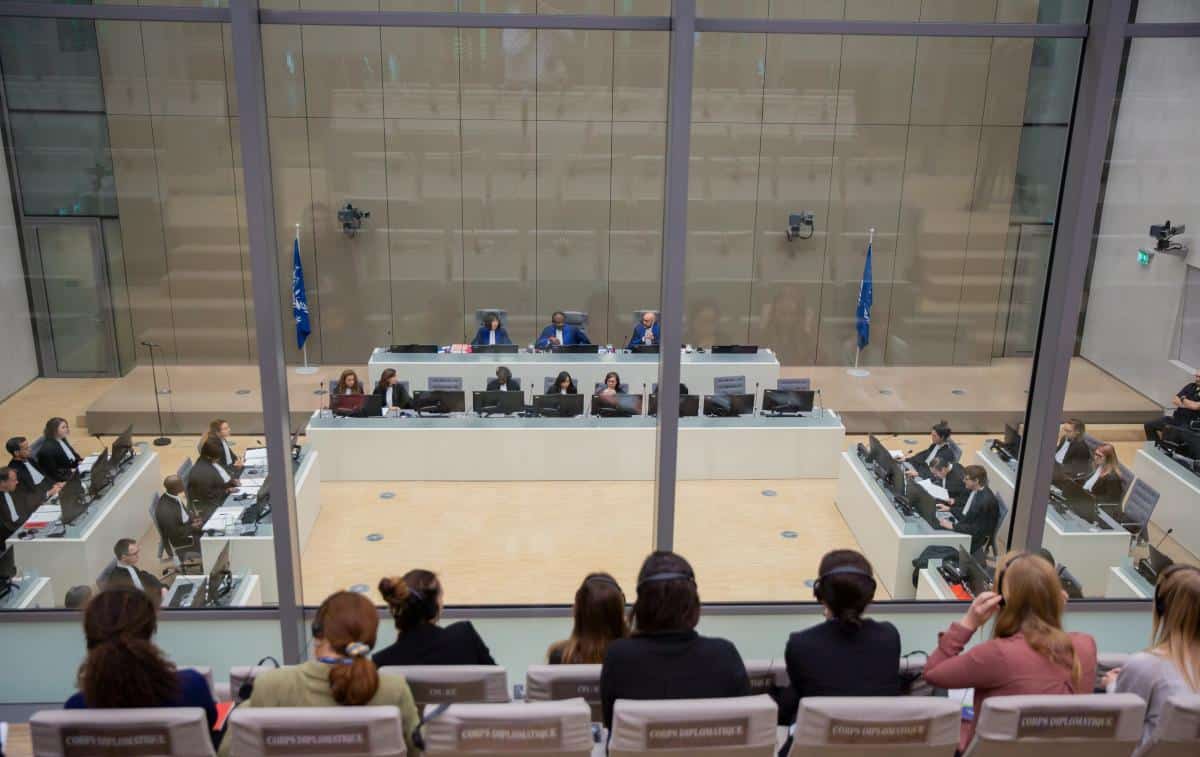
(source: ICC)
Participants are assigned different roles (e.g. Prosecution, Defence, Judges, Registry, Victim Representative, Victim, Audience, Press) and are given a fictious case before the ICC, dealing with CRSV.