Socio-economic consequences and needs
CRSV forces families, communities, and societies to process a collective trauma that has left them shattered. CRSV causes family loss and separation, the collapse of protective networks such as religious communities, creates economic shocks, and causes migration and displacement. These inequalities and vulnerabilities may become more apparent post-conflict and tend to be challenging to recover from due in part to economic disadvantages.
The socio-economic pillar considers not only the impacts on individuals but also explores how these impacts cause a ripple effect on communities and societies at large (how they define social structures, disparities, and opportunity). The following is a non-exhaustive list of consequences related to socio-economic position as a result of CRSV:
- Erosion of community/social cohesion: further violence (such as ethnic/religious tensions and persecution, and honor killings), societal stigmas, ostracization, isolation, the continuation of sexual and gender-based violence, erosion of trust in institutions and norms, exacerbated inequalities, increased need for (and lack of access to) mental health/psychosocial and legal services, long-term social and economic inequalities.
- Economic hardship and disruption of livelihoods: reduced economic opportunity or unemployment due to health and well-being challenges and loss of community structure, participation in harmful coping behaviors (such as educational withdrawal which may lead to gaps in education and skills, informal economic participation or participation in hazardous work), reduced healthcare opportunities, economic dependence.
This section will expand on the following socio-economic consequences of CRSV (and ends with a best practice example on how the socio-economic needs of survivors of CRSV can be addressed):
- Erosion of community/social cohesion: Stigma-induced social isolation and honor-based violence
- Economic hardship and disruption of livelihoods: Reduced economic opportunity due to health and withdrawal from education
I. Erosion of Community/Social Cohesion
CRSV inflicts damage not only to individuals but also to the very fabric of societies which are threatened and compromised by the systematic nature of CRSV. One of the devastating consequences of this is that communities are even further fragmented following conflict, with collective emotions regarding mistrust, fear, and uncertainty. Furthermore, stigma against victims/survivors is a prevalent issue within CRSV-affected societies. Stigma arises from a social instinct to preserve group cohesion, however, it is profoundly damaging to victims/survivors whose prospects of recovery are impacted on every level, all the way to impacting their access to (and experiences with) legal services. This is because rather than addressing the damages that have occurred, victims/survivors may instead have no other option than to internalize and live with their traumas in solitude, particularly in the absence of the possibility of pursuing support or justice.
Stigma impacts, for example, family relationships (as in the case of children born as a consequence of CRSV, who have been considered the “laughing stock” of a community) and marriages (in instances where, for example, women survivors are perceived as unmarriageable), and can manifest as degrading language and attitudes, such as referring to victims/survivors as “‘prostitutes’ that deserved it”. These are just a few examples of how stigmas associated with victims/survivors of CSRV can impact coping and recovery, as social support is paramount to socio-economic development and the repair of communities.
This section looks at some of how these social tensions manifest themselves in society, and how community-based interventions aim to mitigate some of these impacts to promote healing and unity within communities, which is not an easy task as in many instances survivors and perpetrators are living in close proximity, sometimes even in the same household.
Example: Stigma-induced social isolation
The aftermath of CRSV for victims/survivors can include self-isolation or hiding or isolation imposed by others. This is largely influenced by variations of sexual violence stigma. In some societies, for example, isolation may be caused by the motive to “restore” dignity to a household (by keeping survivors hidden), while in some circumstances survivors may be coerced into staying home in an effort (by their spouses or relatives) not to reveal what has happened to them. Victims/survivors may also turn to isolation due to fears of persecution. In some contexts, this is to protect against a very real threat to their safety and survival (caused by possible exposure to further instances of violence following disclosure of rape). The following are two quotes regarding stigmas against Ugandan CRSV survivors, the former from a practitioner and the latter from a male survivor (indeed, male survivors face unique barriers regarding disclosing experiences of rape):
“One of the challenges that survivors of SGBV face is stigma. When the girl is raped, people will start talking ill about her and also blaming her for what happened more, especially the friends and some family members. This leads to her isolation from people.” (Carmen H. Logie, Moses Okumu, Madelaine Coelho, Miranda G. Loutet, Isha Berry, Simon Odong Lukone, Nelson Kisubi, Daniel Kibuuka Musoke, and Peter Kyambadde, “Sexual Violence Stigma Experiences among Refugee Adolescents and Youth in Bidi Bidi Refugee Settlement, Uganda: Qualitative Insights Informed by the Stigma Power Process Framework”, 2023, 6)
“After rape, one loses self-esteem and respect. (…) people are laughing at you. That is when one lives in isolation and loneliness.” (Jocelyn Kelly, Katherine Albutt, Justin Kabanga, Kimberley Anderson, and Michael Van Rooyen, “Rejection, Acceptance and the Spectrum Between: Understanding Male Attitudes and Experiences towards Conflict-Related Sexual Violence in Eastern Democratic Republic of Congo”, 2017, 4)
In any case, stigmatizing beliefs and the resulting efforts to silence victims/survivors restrict access to support services (including legal) which would be protective against long-term physical, psychological, and socio-economic consequences. Survivors may have access to life-saving medications for illnesses such as HIV prolonged, develop post-traumatic stress, and so on. These issues may be further exacerbated by other manifestations of isolation, and in some cases, survivors may even stop attending faith-based meetings and other such opportunities for connection and community. This is particularly damaging as some of the key ways of coping with the aftermath of CRSV as a victim/survivor (especially in the absence of psychological support or intervention) include religion or other meaningful ways of finding purpose in life, opportunities that provide connection, community, and a sense of belonging.
Overall, stigma prevents the survivor from being “known”, and such a barrier against connection comes with many ramifications. This affects not only the opportunities and experiences of the individual but contributes to social cohesion being undermined, as collective recovery cannot be as easily explored, along with root causes being more likely to remain unaddressed.
Example: Honor-Based Violence (HBV)
Honor-Based Violence (HBV) refers to violence carried out to restore “honor” to a family after a victim/survivor becomes perceived as dishonorable or “tainted”. Forms of HBV include physical violence such as hitting or kicking, strict monitoring (related to the aforementioned silencing and isolation that may occur), abandonment, or it can even take the form of forced suicide or honor killing (murder). Furthermore, HBV is rooted in cultural beliefs, particularly regarding gender norms and rules of marriage, and is particularly prevalent within societies where religious values (such as purity and sanctity) are emphasized or where collective identity is an important element of social belonging. HBV is disproportionately committed against women.
There are various instances in which CRSV may lead to the consequence of HBV, however, each of these cases has in common the fact that they shed light on stigmas regarding sexuality. For women, rape being equated with adultery (sex outside of marriage) may compel relatives, spouses, or community members to commit HBV, such as repeated beatings (referred to as flogging). One such example, highlighted by Amnesty International, would be the violence perpetrated against 13-year-old Aisha Ibrahim Duhulow in Somalia, after reporting that she had been raped by three men. In 2008, she was stoned to death by 50 Al-Shabab and clan militia, in front of 1,000 spectators. Reports claim that she was presumed to be older than her age and married.
In places where homosexuality is still against the law, men who are victims/survivors of CRSV bear the risk of incarceration, and experiencing violence that can be life-threatening, including severe injuries from beatings or extrajudicial execution (such as being stoned to death). The following website – of the Human Dignity Trust – lists in which countries people with lesbian, gay, bisexual, transgender, and queer, sexual orientations are against the law and also where they are punishable with the death penalty: https://www.humandignitytrust.org/lgbt-the-law/map-of-criminalisation/
As with other instances of stigma, the prevalence of HBV leaves less possibility for healthy coping with traumas and may lead to the use of negative coping mechanisms. Other means of restoring honor that does not involve violence include, for example, forced marriages to “absolve” the reputation of a family.
II. Economic Hardship and Disruption of Livelihoods
Conflict causes numerous challenges to maintaining one’s livelihood, from physical health challenges that may make work impossible to loss of homes and other property or assets that previously provided sustenance (e.g. loss of means for agriculture). This consequence has far-reaching ramifications, from increasing the risk of food insecurity to exacerbating poverty to heightening the risks of re-victimization (sexual or exploitative through related issues such as forced migration or displacement). On top of these consequences of conflict, victims/survivors of CRSV face added economic challenges. As in many societies women are already less likely to work, CRSV further highlights disparities between men and women in terms of economic opportunity and empowerment.
Example: Reduced economic opportunity due to health
CRSV can severely limit the opportunity that victims/survivors have to participate in economic activities simply due to the health and well-being ramifications that impact everyday life. This consequence results from increased physical and psychological needs, which require attention and take priority. For example, physical consequences (damage to internal organs, painful lesions, etc.) can lead to medical interventions, such as surgeries, which require extended periods of recovery. Unexpected and unwanted pregnancies resulting from rape can prevent a victim/survivor from working due to childcare needs or possible further physical complications (such as complicated childbirth experiences which can further traumatize and require medical intervention). STIs can require consistent administration of medications that interrupt economic participation. All of this not to mention the psychological impacts, which create just as significant barriers to participation in terms of the ability to engage and perform. In stigmatizing environments, the consequences of CRSV as they pertain to economic participation are even more difficult to manage, as they are not met with an understanding or flexibility around such experiences/consequences.
Example: Withdrawal from (and/or inability to participate in) education
CRSV may result in educational institutions being damaged and remaining non-functioning, but beyond this, victims/survivors may withdraw from education as a result of other consequences afflicted by CRSV (such as physical health problems, e.g. fistula, or psychological difficulties). As a result, the education and skills gaps that already exist between men and women increase, and women’s economic dependence alongside that. This causes further discrimination against women in the long term and hinders their economic empowerment and ability to separate from circumstances in which their autonomy is disregarded and in which further instances of sexual violence may occur (leading to further exposure to forced prostitution, generally bad work conditions, and so on). Furthermore, down the line, these dynamics make it more challenging for societies to overcome cycles of poverty, stemming, for one, from the unique barriers to economic participation that disproportionately affect women.
III. Bèkske: Rwandan Empowerment Coffee: A Best Practice Example of a Social Enterprise
Many socio-economic interventions for addressing the impacts of CRSV emphasize investing in women’s economic participation due to the positive rippling effects on the well-being of individuals and society resulting from women’s economic empowerment. The story of Bèkske: Rwandan Empowerment Coffee tells one such story, in which socio-economic interventions can transform the lives of survivors of genocidal sexual violence. Bèkske produces and sells specialty coffee together with 75 female coffee entrepreneurs who are also survivors of the genocide against the Tutsi in 1994 in Rwanda, including sexual violence. Since its launch as a project through a collaboration between the Mukomeze Foundation in the Netherlands (a charity supporting survivors of genocidal sexual violence in Rwanda) and Solace Ministries in Rwanda (a non-profit faith based organization set up by genocide survivors providing community and comfort in a holistic manner to other genocide survivors), Bèkske became an independent organisation in 2019 that has provided sustenance for over 75 survivors (primarily women who survived genocidal sexual violence) and their families/communities, together with – again – partner Solace Ministries.
Watch the Mukomeze video on the work that Mukomeze does together with Solace Ministries (including footage of the female coffee entrepreneurs):
(Source: YouTube, Mukomeze Foundation)
Bèkske’s business model has offered survivors transparent economic support and economic independence and therefore reflects a best practice example within socio-economic initiatives to address the impacts of CRSV. It does so by using a social impact model that prioritizes the needs of survivors of CRSV, allowing them to actively participate in the development of the project. The coffee entrepreneurs earn four times more than most other coffee farmers and on top of that share for 25% in the profit. Bèkske contributes to various UN Sustainable Development Goals (SDGs), such as ending poverty (1), contributing to good health and well-being (3), quality education (4), gender equality (5), decent work and economic growth (8), and responsible consumption and production (12). Together, these focuses contribute to the physical, psychological, social, economic and spiritual healing of survivors. In 2022, the UN – in its white paper on private sector opportunities for engagement: addressing CRSV – praised the Bèkske company, as being an example of how social enterprises outside the countries concerned can still make a meaningful impact on the lives of survivors of CRSV.
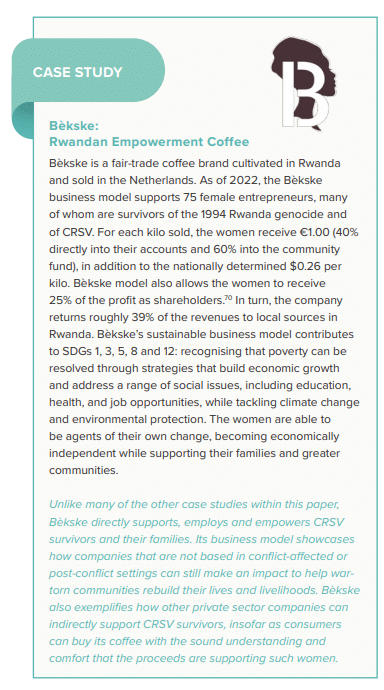
(Source: UN Action against Sexual Violence in Conflict, Addressing Conflict-Related Sexual Violence: Private Sector Opportunities for Engagement, 2022, 29)
The economic empowerment of women translates to increased “bargaining power” for women. Research shows that when women participate in labor, men in society are less inclined to treat them in accordance with stigmatized opinions or attitudes, as they are regarded as “productive members of the household” (Alesina et al. (2021)). This view is contestable in and of itself, however, it remains that the ability and opportunity to participate economically is advantageous for women and their autonomy in many ways.
Economic empowerment can take many forms, ranging from financial aid through international funds, job placements, vocational training, microfinance programs, practical support with household maintenance, educational sponsorships, and grants, as well as literacy training. Furthermore, improving the socio-economic prospects of victims/survivors helps address many of the root causes of CRSV, including poverty, gender inequality, and the weaponization of sexuality.

Sources ( a selection):
- Carmen H. Logie, Moses Okumu, Madelaine Coelho, Miranda G. Loutet, Isha Berry, Simon Odong Lukone, Nelson Kisubi, Daniel Kibuuka Musoke, and Peter Kyambadde, “Sexual Violence Stigma Experiences among Refugee Adolescents and Youth in Bidi Bidi Refugee Settlement, Uganda: Qualitative Insights Informed by the Stigma Power Process Framework”, SSM – Mental Health, Vol 4, Issue 5 (2023), 1-11.
- Maureen Murphy, Mary Ellsberg, Manuel Contreras-Urbina, “Nowhere to go: Disclosure and Help-Seeking Behaviors for Survivors of Violence against Women and Girls in South Sudan”, Conflict and Health, Vol. 14, Issue 6 (2020), 1-11.
- Lindsey Green, Thomas McHale, Ranit Mishori, Linda Kaljee, and Shahanoor Akter Chowdhury, “Most of the Cases are Very Similar.”: Documenting and Corroborating Conflict-Related Sexual Violence Affecting Rohingya Refugees”, BMC Public Health, Vol. 22, Issue 700 (2022), 1-14.
- Kennedy Amone-P’Olak, Tlholego Molemane Lekhutlile, Emilio Ovuga, Rosemary Ann Abbott, Richard Meiser-Stedman, David Gage Stewart, and Peter Brian Jones, “Sexual Violence and General Functioning among Formerly Abducted Girls in Northern Uganda: The Mediating Roles of Stigma and Community Relations – The WAYS Study”, BMC Public Health, Vol. 16, Issue 64 (2016), 1-10.
- Jocelyn Kelly, Katherine Albutt, Justin Kabanga, Kimberley Anderson, and Michael Van Rooyen, “Rejection, Acceptance and the Spectrum Between: Understanding Male Attitudes and Experiences towards Conflict-Related Sexual Violence in Eastern Democratic Republic of Congo”, BMC Women’s Health, Vol. 17, Issue 127, (2017), 1-11.
- Geraldine A. Gregory, Jayne Fox, and Bal Kaur Howard, “Honour-Based Violence: Awareness and Recognition”, Paediatrics and Child Health, Vol. 30, Issue 11 (2020), 365-370.
- Evelyn Josse, “‘They Came with Two Guns’: The Consequences of Sexual Violence for the Mental Health of Women in Armed Conflicts”, International Review of the Red Cross, Vol. 92, Issue 877 (2010), 1-19.
- Alberto Alesina, Benedetta Brioschi, and Eliana La Ferrara, “Violence against Women: A Cross-Cultural Analysis for Africa”, National Bureau of Economic Research, 88, Issue 349 (2021), 70-104.
- UN Action against Sexual Violence in Conflict, Addressing Conflict-Related Sexual Violence: Private Sector Opportunities for Engagement, 2022.
Assignment
Please pick one of the below assignments.
(1) In some instances, victims/survivors have no choice but to live in the same environment as the perpetrator (either within the same community or even within the same household). Which socio-economic factors contribute to the risk of further perpetration in these environments? How can socio-economic interventions address these risks?
(2) Create a business plan (either in text or presentation format) in which you propose a socio-economic intervention for survivors of CRSV. This intervention can take any form (e.g. a project or an organization, victim/survivor or perpetrator focus, or both). Consider whether interventions follow best-practice guidelines, such as having a holistic perspective, being evidence-based, and survivor-centric.