
Variation of CRSV
Conflict-related sexual violence can, for instance, take place in isolation, as part of a systematic attack, or used as a weapon of war. No conflict is the same. CRSV is not a single phenomenon: it has many forms, perpetrators, and survivor profiles, and can happen at different frequencies across contexts. It may also be hardly (or not be) committed at all; and is thus preventable. It is important to understand the variation in which CRSV appears as it informs both prevention and ways to address the crime.

Sources
- Elisabeth Jean Wood, “Variation in Sexual Violence During War”, Politics and Society, Vol. 34, Issue 3 (2006), 307-342.
- Elisabeth Jean Wood, “Armed Groups and Sexual Violence: When is Wartime Rape Rare?”, Politics and Society, Vol. 37, Issue 1 (2009), 131-161.
- Dara Kay Cohen, “Explaining Rape during Civil War: Cross-National Evidence (1880–2009)”, American Political Science Review, Vol. 107, Issue 3 (August 2013), 461-477.
- Dara Kay Cohen, Rape During Civil War (Ithaca, New York, Cornell University Press, 2016).
- Meredith Loken and others, “Deploying Justice: Strategic Accountability for Wartime Sexual Violence”, International Studies Quarterly, Vol. 62, Issue 4 (2018), 751-764.
- Ragnhild Nordås and Dara Kay Cohen, “Conflict-Related Sexual Violence”, Annual Review of Political Science, Vol. 24 (2021), 193-211.
- Mara Redlich Revkin and Elisabeth Jean Wood, “The Islamic State’s Pattern of Sexual Violence: Ideology and Institutions, Policies and Practices”, Journal of Global Security Studies, Vol. 6, Issue 2 (2021).
- Sexual Violence in Armed Conflict Dataset (1989-2019).
Motivation of Perpetrators
Perpetrators of CRSV may have different reasons for committing sexual violence. These reasons may be influenced by the context of the conflict, the resources of the war, the ideologies of the war, and the justifications of the groups/individuals committing the acts. These reasons may change over time and can vary depending on the form of CRSV. Understanding the motivations can help prevent CRSV by addressing warning signs and risk factors, and by informing policy and other prevention efforts.
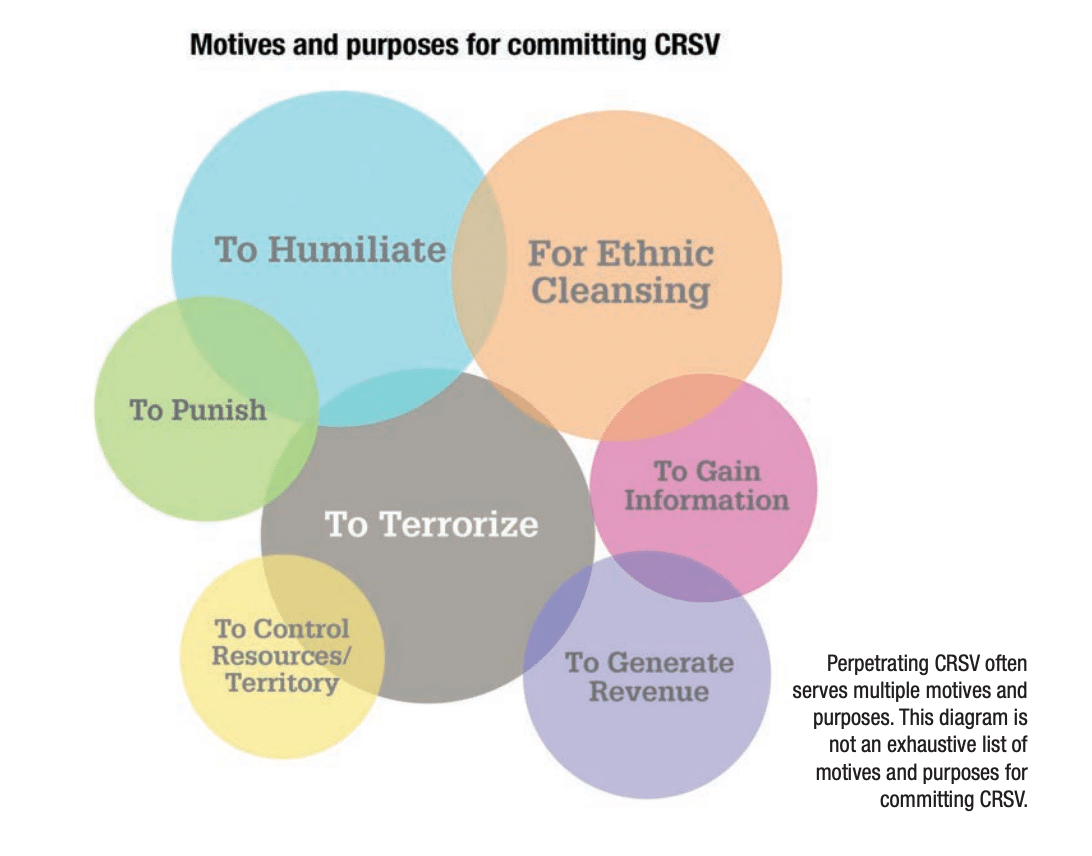
(Source: UN, Handbook for United Nations Field Missions on Preventing and Responding to Conflict-Related Sexual Violence, 2020, p. 12)
Motives are not mutually exclusive and are difficult to differentiate on a case-by-case basis. However, some known motivations include:
- Sexual violence may be seen as a readily-available weapon/military tactic that can be used to subjugate populations, cause fear, seize land, displace and disrupt community/family structures (a tactic of war/genocide/ethnic cleansing/terrorism). In 2018, in South Sudan, allied militias raped women and girls as part of a campaign to drive opponents out of southern Unity State. Sexual violence was also used as a means of repression, terror, and control.
- Sex may be seen by perpetrators as a “basic” need, and many times references are made to wives not being present. The general impunity context in conflict situations, makes this even more possible.
- The chaos of conflict can spotlight negative attitudes toward women and attitudes regarding gender roles as a whole, e.g. masculinity. This chaos makes it possible to, for instance, commit CRSV to members of a different ethnic group. Sexual violence against women in a context where women’s bodies are seen as the property of men can also be seen as an attack on enemy combatants.
- The overall context of conflict with a high level of dependency of victims on food and security, makes them prone to become victims of CRSV, whereby the perpetrators demand sexual acts in exchange of e.g. food, shelter or crossing the border, without fear of punishment.
- Military training and structures may create a loss of personal identity and dissolution of personal beliefs and morals, providing perpetrators with justification to express personal needs for power or sexual gratification. CRSV (often gang rape) may also create bonds of friendship, cohesion and trust between forcibly recruited members.
- Use of stimulants or other psychoactive substances which impair rational judgment and predispose to or heighten aggression, as well as other influences from peers or superiors, heighten the risk of CRSV. In addition, superstitious reasons may influence why perpetrators commit CRSV.
- CRSV is used to intimidate, torture and extract information from the victims in the course of an interrogation.
- CRSV may be a non-military policy, to control the sexual and reproductive lives of combatants (to force females to take oral contraception to avoid pregnancy).
- CRSV may be used to create a new ethnic group or a new group of, such in Cambodia under the Khmer Rouge, laborers.
- CRSV as a “pull factor”: the availability of women may be used to attract soldiers to join the forces. Moreover, women are sold as slaves to finance the groups’ activities and by collecting ransom payments from traumatized communities. Examples can be found with the terrorist group Islamic State of Iraq and the Levant.
- CRSV to dehumanize the combatants, to cut the ties between recruits and their communities, so they cannot return home. For example, in Somalia, Al Shabaab used sexual violence as a ritual initiation process to cut the bonds of new recruits to civil society. In Uganda, the Lord’s Resistance Army used sexual slavery as part of their long-term strategy to detach combatants from society and thereby enhance allegiance within the group.
Sources
- Maria Eriksson Baaz and Maria Stern, “Why Do Soldiers Rape? Masculinity, Violence, and Sexuality in the Armed Forces in the Congo (DRC)”, International Studies Quarterly, Vol. 53, Issue 2 (2009), 495-518.
- Erin Baines, “Forced Marriage as a Political Project: Sexual Rules and Relations in the Lord’s Resistance Army”, Journal of Peace Research, Vol. 51, Issue 3 (2014), 405-417.
- Amelia Hoover Green, “The Commander’s Dilemma: Creating and Controlling Armed Group Violence”, Journal of Peace Research, Vol. 53, Issue 5 (2016), 619-632.
- Angela Muvumba Sellström, “Burundi’s Rebel Groups and the Stigmatisation of Wartime Sexual Violence”, Journal of Sexual Aggression, Vol. 25, Issue 3 (2019), 275-291.
- Katherine Sawyer and others, “Rebel Leader Ascension and Wartime Sexual Violence”, The Journal of Politics, Vol. 83, Issue 1 (2021), 396-400.
- Mayesha Alam and Elisabeth Jean Wood, “Ideology and the Implicit Authorization of Violence as Policy: The Myanmar Military’s Conflict-Related Sexual Violence against the Rohingya”, Journal of Global Security Studies, Vol. 7, Issue 2 (2022).
Listening to Perpetrators
Watch the interview with Congolese perpetrators of CRSV to hear why they committed CRSV (“Congo soldiers explain why they rape”):
Watch the trailer of “DRC: Weapon of War: Confessions of Rape in Congo” by Ilse and Femke van Velzen (2009):
(note: the film can be watched in full against payment)
Assignment 1
Motivation of Perpetrators of CRSV
Look up 3 countries in which CRSV is or has been committed. Who are the perpetrators of CRSV and what motivates them to commit CRSV? Is their overlap and differences in the motivation of the perpetrators to commit CRSV in these three countries, and if so, explain?