The Policy Level
a. UN Security Council Resolutions on “Women, Peace and Security”
The recognition of CRSV as a crime in international (criminal) law and national criminal law has furthermore been accompanied by an increased attention at the international policy level. It could be held that international law together with United Nations Security Council (UNSC) Resolutions form the normative framework on CRSV.
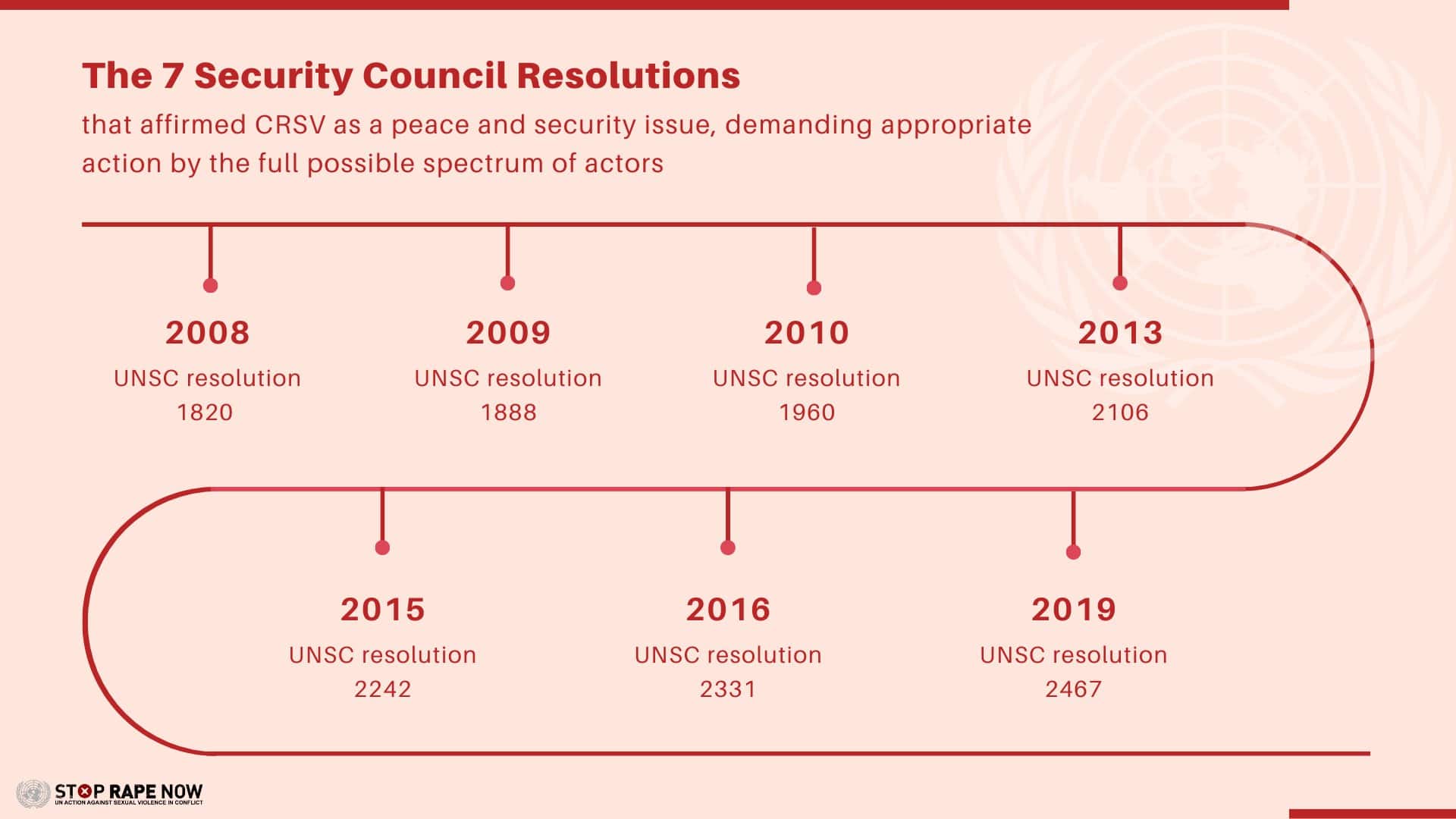
The first UNSC Resolution on Women Peace and Security (WPS), i.e. UNSC Resolution 1325, was adopted in October 2000. It was the first resolution to link women to the so-called “women, peace and security agenda” by acknowledging that armed conflicts impact women and girls differently from men and boys and the need for women’s active and effective participation in peacemaking, including peace processes and peacebuilding. The WPS agenda is based on four pillars: participation, prevention, protection, and relief and recovery. The first resolution also recognised that CRSV is often witnessed in conflict situations with devastating impacts. While some subsequent resolutions on WPS are more focussed on women’s active and effective participation in peacemaking and peacebuilding; others are more focussed on preventing and addressing CRSV, starting with UNSC Resolution 1820 from 2008.
UNSC Resolution 1820 (2008) acknowledged that sexual violence, when used as a tactic of war, can be a threat to international peace and security. This and subsequent WPS Resolutions have, for example, recognized the often strategic use of CRSV and dispelled the myth that sexual violence is only committed against women and girls. An important aspect of the WPS agenda was also the appointment of a Special Representative of the Secretary-General on Sexual Violence in Conflict, to lead and cohere system-wide efforts, promoting cooperation and coordination primarily through the interagency UN Action Network. In addition, the UN Security Council created a Team of Experts on the Rule of Law and Sexual Violence in Conflict to enhance national criminal accountability and end impunity.
(source: UN Action against Sexual Violence in Conflict)
Some of the most important issues addressed in the five UNSC Resolution of WPS dealing specifically with CRSV concern first and foremost:
1820 (2008)
• Declares that rape and other forms of sexual violence are no longer considered an inevitable by-product of armed conflict and, depending on the context, may constitute a war crime, a crime against humanity or an act of genocide.
• Recognises that prevention of and response to CRSV can contribute to the maintenance of international peace and security.
• Urges the Secretary-General and his Special Envoy to include women in peace processes, including those related to the prevention of conflict.
• Calls for the cessation of impunity and proposes the development of mechanisms to provide protection against violence for women and girls.
• Notes the coordination role of the inter-agency initiative UN Action against Sexual Violence in Conflict.
1888 (2009)
• Urges parties to conflict to report and investigate acts of sexual violence.
• Calls for the appointment of a Special Representative of the Secretary-General on Sexual Violence in Conflict, to lead and cohere system-wide efforts, promoting cooperation and coordination primarily through the interagency UN Action network.
• Calls for the deployment of Women Protection Advisors as well as a Team of Experts on the Rule of Law and Sexual Violence in Conflict.
1960 (2010)
• Calls for development of an accountability infrastructure for sexual violence in conflict to end impunity.
• Requests the Secretary-General to list in an annex to the annual report parties that are credibly suspected of committing or being responsible for patterns of rape and other forms of sexual violence in situations of armed conflict on the Security Council agenda.
• Calls upon parties to armed conflict to implement time-bound commitments to end sexual violence in conflict.
• Calls for monitoring, analysis and reporting arrangements on conflict-related sexual violence.
2106 (2013)
• Emphasises the need to increase women’s participation in mediation, post-conflict recovery and peacebuilding efforts to address sexual violence in conflict.
• Underlines the importance of all actors in accountability measures to end impunity.
2467 (2019)
• Recognises structural root causes of sexual violence in conflict, including gender inequality.
• Calls for a survivor-centred approach to prevention and response efforts, including in peace processes and other reform efforts.
• Calls for strengthening justice and accountability mechanisms by use of sanctions and the provision of reparations.
(source: partly based on: UN Action against Sexual Violence in Conflict: Stop Rape Now, Framework for the Prevention of Conflict-Related Sexual Violence, 2022, 9)
(source: UN Secretary-General on Sexual Violence in Conflict, Annual Report 2023)
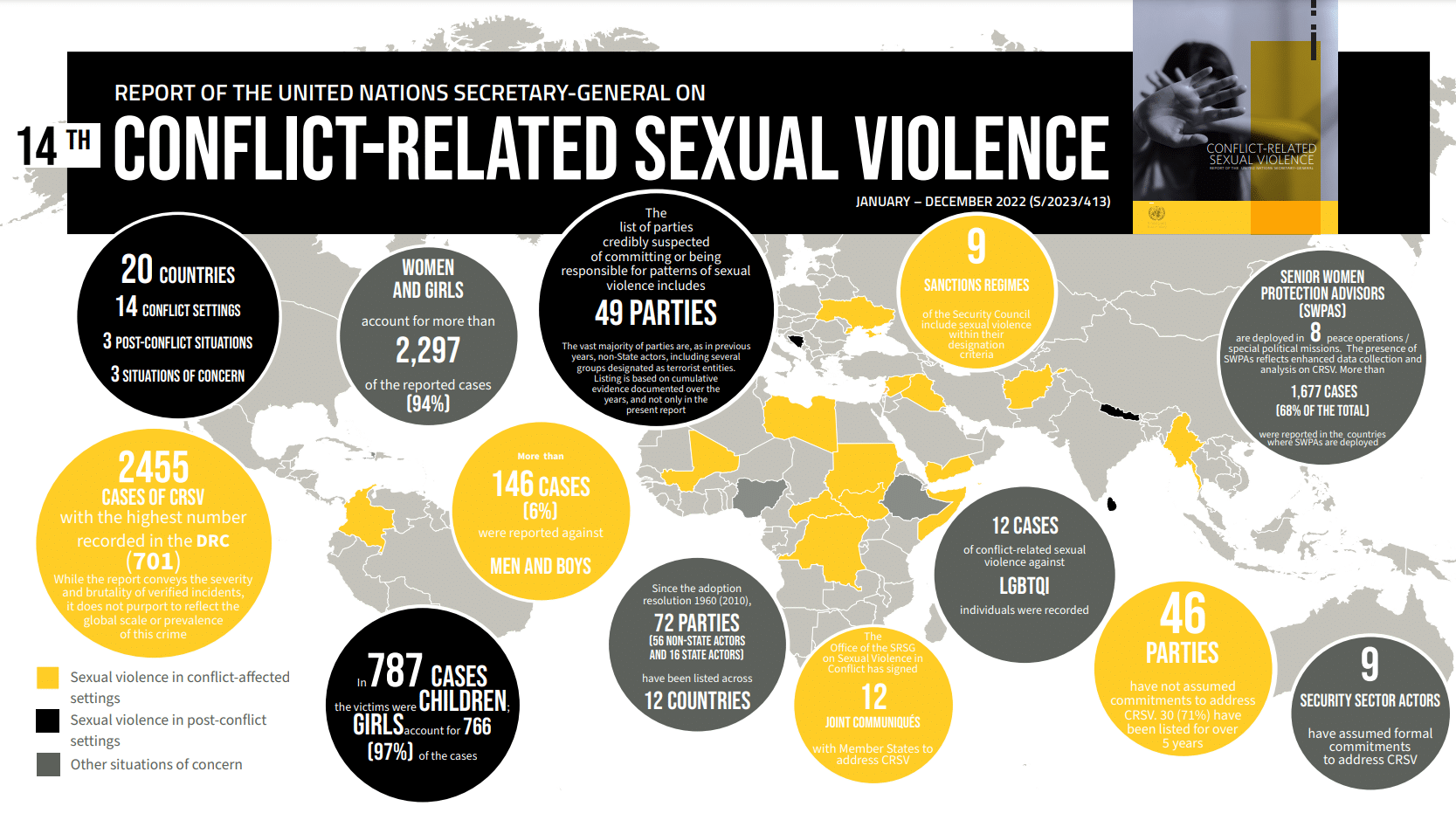
Each year, the UN Secretary-General produces a global report on sexual violence in situations of armed conflict and post-conflict. The report contains a list of parties that are credibly suspected of committing or being responsible for acts of CRSV and tracks implementation of commitments taken by these parties. In its 2023 report over the year 2022, it highlighted that 49 parties (mostly non-state actors, including terrorist entities) in 20 countries were credibly suspected of committing or being responsible for patterns of sexual violence. A total of 2455 cases of CRSV had been reported against women, men, children, and LGBTQI individuals with the highest number in the Democratic Republic of the Congo. In the report, the UN Secretary-General provides recommendations to the UNSC, States, and other stakeholders (e.g. donors, regional and intergovernmental organizations) to prevent, end and address CRSV.
Enforcement
UNSC Resolutions – in which the formal expressions of the opinion or will of the Security Council are laid down – are legally binding for the Member States. The UNSC Resolutions on WPS are moreover further developed on the national or regional level (e.g. EU and NATO) via National Action Plans (NAP), so that the broader WPS agenda is effectively implemented on those levels. By the end of 2023, 107 UN Member States had adopted a 1325 National Action Plan. For example, the Netherlands adopted its already fourth NAP on WPS (2021-2025). In this NAP, the Netherlands committed itself to work towards five strategic outcomes: participation; prevention; protection; relief, reconstruction and recovery; and WPS mainstreaming, having both an international and a national focus on the WPS agenda. CRSV is also a topic of concern in the Dutch NAP, in particular where it concerns the protection of these victims, the prosecution of these crimes, and relief/reconstruction/recovery provided to them.
There is still a long road to travel. More effective implementation of the UNSC Resolutions and NAPs all around the world is still very much needed. For example, in the Dutch NAP it can be read that “more than half of all migrant women and girls experience, sexual violence or human trafficking before, during or after they migrate, either directly or indirectly. (…) Over the past 10 years, 65 state and non- state parties to conflicts in 11 different countries have been identified as being guilty of perpetrating conflict-related sexual violence on a massive scale.” Yet, despite remarkable progress in putting CRSV at the centre of international attention/policy over the past decades, implementation lacks behind severely.
b. Sustainable Development Goals (SDGs)
(source: UN SDG website)
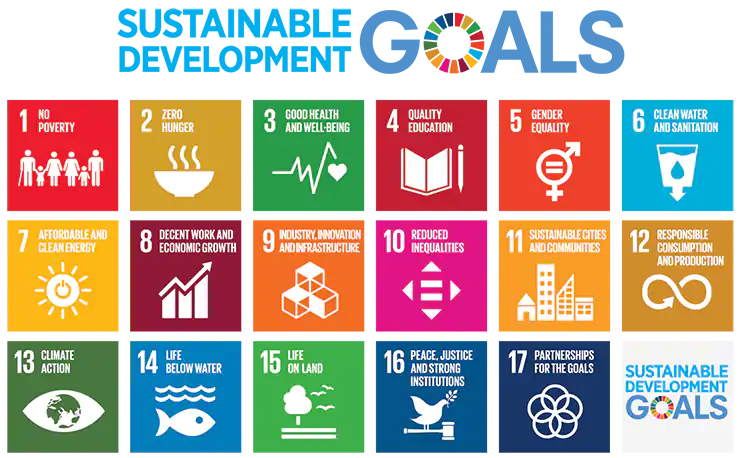
International obligations adopted earlier and later than the UNSC Resolutions on WPS have also strengthened the world’s commitment to the WPS agenda. These include, for example, the already mentioned 1979 CEDAW Convention, the 2013 Arms Trade Treaty and the Sustainable Development Goals (SDGs) agreed for the period 2015-2030.
According to the UN: “The Sustainable Development Goals are a universal call to action to end poverty, protect the planet and improve the lives and prospects of everyone, everywhere. The 17 Goals were adopted by all UN Member States in 2015, as part of the 2030 Agenda for Sustainable Development which set out a 15-year plan to achieve the Goals. Today, progress is being made in many places, but, overall, action to meet the Goals is not yet advancing at the speed or scale required.”
Preventing and addressing conflict-related sexual violence also contributes to the achievement of the 2030 Agenda for Sustainable Development by addressing specific targets related to: ensuring good health and well-being for all at all ages (SDG 3); achieving gender equality and empower all women and girls (SDG 5); reducing inequality within and among countries (SDG 10) and promoting peace; and justice and strong institutions (SDG 16), in particular.
Target 3.3: By 2030, end the epidemics of AIDS, tuberculosis, malaria and neglected tropical diseases and combat hepatitis, water-borne diseases and other communicable diseases.
Target 3.7: By 2030, ensure universal access to sexual and reproductive health-care services, including for family planning, information and education, and the integration of reproductive health into national strategies and programmes.
Target 3.8: Achieve universal health coverage, including financial risk protection, access to quality essential health-care services and access to safe, effective, quality and affordable essential medicines and vaccines for all.
Target 5.1: End all forms of discrimination against all women and girls everywhere.
Target 5.2: Eliminate all forms of violence against all women and girls in the public and private spheres, including trafficking and sexual and other types of exploitation.
Target 5.3: Eliminate all harmful practices, such as child, early and forced marriage and female genital mutilation.
Target 5.5: Ensure women’s full and effective participation and equal opportunities for leadership at all levels of decision-making in political, economic and public life.
Target 5.6: Ensure universal access to sexual and reproductive health and reproductive rights as agreed in accordance with the Programme of Action of the International Conference on Population and Development and the Beijing Platform for Action and the outcome documents of their review conferences.
Target 5.a: Undertake reforms to give women equal rights to economic resources, as well as access to ownership and control over land and other forms of property, financial services, inheritance and natural resources, in accordance with national laws.
Target 5.c: Adopt and strengthen sound policies and enforceable legislation for the promotion of gender equality and the empowerment of all women and girls at all levels.
Target 10.2: By 2030, empower and promote the social, economic and political inclusion of all, irrespective of age, sex, disability, race, ethnicity, origin, religion or economic or other status.
Target 10.3: Ensure equal opportunity and reduce inequalities of outcome, including by eliminating discriminatory laws, policies and practices and promoting appropriate legislation, policies and action in this regard.
Target 16.1: Significantly reduce all forms of violence and related death rates everywhere.
Target 16.2: End abuse, exploitation, trafficking and all forms of violence against and torture of children.
Target 16.3: Promote the rule of law at the national and international levels and ensure equal access to justice for all.
Target 16.4: By 2030, significantly reduce illicit financial and arms flows, strengthen the recovery and return of stolen assets and combat all forms of organized crime.
Target 16.6: Develop effective, accountable and transparent institutions at all levels.
Target 16.7: Ensure responsive, inclusive, participatory and representative decision-making at all levels.
Target 16.a: Strengthen relevant national institutions, including through international cooperation, for building capacity at all levels, in particular in developing countries, to prevent violence and combat terrorism and crime.
Target 16.b: Promote and enforce non-discriminatory laws and policies for sustainable development.
c. Preventing Sexual Violence in Conflict Initiative (PSVI)
Another notable development that has brought CRSV to the attention of the world and its leaders is the Preventing Sexual Violence in Conflict Initiative (PSVI). The initiative is part of the UK’s Foreign, Commonwealth & Development Office and was founded in 2012. The aims of the PSVI are to: “raise awareness of the extent of sexual violence against women, men, girls and boys in situations of armed conflict and rally global action to end it.” The “UK leadership of PSVI has driven forward the efforts of governments, militaries, international organisations and civil society to establish a number of UN resolutions and G8 declarations addressing this issue. In 2014 the UK hosted the first ever Global Summit to End Sexual Violence in Conflict which cemented global political will and put PSVI firmly on the world map and the international peace and security agenda.” In 2022, the second Global Summit was held in London. The PSVI works “closely with other governments, international organisations, Parliamentarians, civil society, survivor groups, experts and practitioners from around the world in the fight against sexual violence.” The PSVI is led by the Prime Minister’s Special Representative on Preventing Sexual Violence in Conflict. It has furthermore a PSVI Team of Experts (ToE), which is “a flexible and diverse pool of skilled individuals, managed by the UK Government’s Stabilisation Unit – who deploy to fragile and conflict-affected states to assist the UK government delivery of national security priorities.” The PSVI has developed several important declarations and documents, including the International Protocol on the Documentation and Investigation of Sexual Violence in Conflict; the 2013 Declaration of Commitment to End Sexual Violence in Conflict; and the 2013 G8 Declaration on Preventing Sexual Violence in Conflict. During the 2022 Global Summit, more than 50 countries and the UN agreed that urgent action to end CRSV is direly needed and signed the 2022 Political Declaration. Countries thereby agreed to take action to address causes such as gender inequality, remove stigma faced by victims, and to make sure national laws are in place to prosecute perpetrators. Around 40 countries have also made national commitments outlining the steps they will take to tackle CRSV. It is commendable that a state, the UK, takes a leading role in the fight against CRSV.

Assignment
What kind of obligations does your country have when it comes to preventing and addressing CRSV? By answering this question, you can make use of the Guidebook for States Obligations on CRSV and the relevant databases (also included in the Guidebook), where you can check whether your country has ratified the particular international instruments. In addition, what other commitments did they take up (e.g. NAP on WPS, SDGs, signing protocols).