Use of terminology
The terminology used to describe conflict-related sexual violence has varied and it is not always clear what the differences and commonalities are. Some of the most commonly used terms are: conflict-related sexual violence (CRSV); sexual violence in conflict (SViC), (sexual and) gender-based violence (SGBV or GBV), and sexual violence as a weapon of war or method of warfare (SVMW). In addition, the specific sexual violence crimes (e.g. rape, sexual slavery, enforced prostitution) have been prohibited in law as international crimes, i.e. as war crimes, crimes against humanity, and genocide. Before international criminal tribunals and courts, such as the International Criminal Court (ICC), elements of the specific sexual violence crimes have been established, both in law and jurisprudence. In addition, before some national courts these crimes have also been laid down and prosecuted, albeit in different wording and ways, respectively.
CRSV
“The term “conflict-related sexual violence” (CRSV) refers to rape, sexual slavery, forced prostitution, forced pregnancy, forced abortion, enforced sterilization, forced marriage and any other form of sexual violence of comparable gravity perpetrated against women, men, girls or boys that is directly or indirectly linked (temporally, geographically or causally) to a conflict. This link with conflict may be evident in the profile of the perpetrator (often affiliated with a State or non-State armed group), the profile of the victim (who is frequently a member of a persecuted political, ethnic or religious minority), the climate of impunity (which is generally associated with State collapse), cross-border consequences (such as displacement or trafficking in persons) and/or violations of the terms of a ceasefire agreement.” In addition, it has been recognized that sexual violence can be part of the strategic objectives and ideology of certain terrorist groups (“profile of the perpetrator”) and that the victim can be targeted on the basis of gender inequality or of actual or perceived sexual orientation or gender identity (“profile of the victim”).
This definition first appeared in the Report of the UN Secretary-General on Conflict-Related Sexual Violence on 20 April 2016 (S/2016/361, para. 2) and has been reaffirmed and referenced in subsequent UN reports (including S/2017/249, S/2018/250, S/2019/280, S/2020/487, S/2021/312 and S/2022/272).
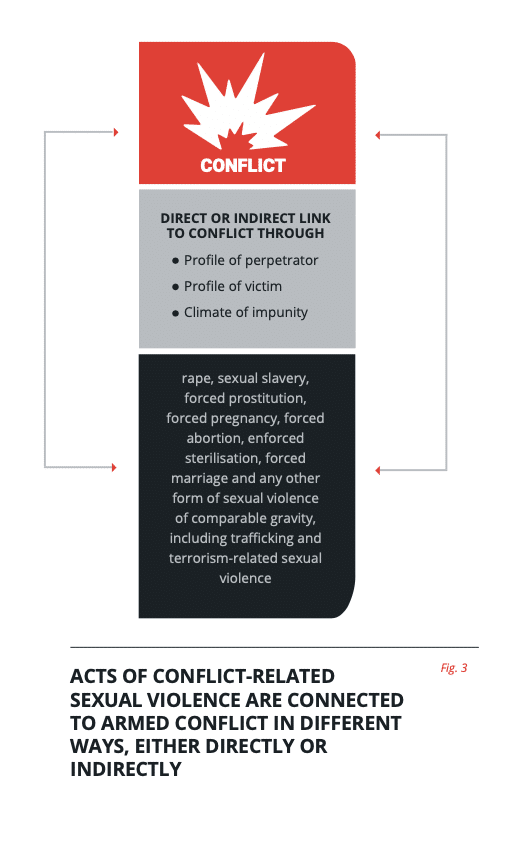
(Source: UN Action Against Sexual Violence in Conflict, Framework for the Prevention of Conflict-Related Sexual Violence, 2022, p. 12)
SViC
Sexual Violence in Conflict (SViC) is distinguishable from CRSV in that it can only take place during an armed conflict. CRSV is a broader term as it can occur during armed conflict, but also in pre- and post-conflict situations. The sexual violence crimes are the same under both definitions.
SVMW
Sexual violence as a method of warfare (SVMW) is the strategic use of sexual violence as a deliberate method or tactic of warfare (also referred to as sexual violence as a weapon of war). For example, a deliberate method of warfare to undermine the opposition, or as a tactic to control one’s own armed group/military. SVMW can be considered to be a subcategory of CRSV. SVMW can only occur during armed conflict and it requires that the act(s) be a deliberate method or tactic during the conflict; it is distinguished from opportunistic sexual violence or sexual violence tolerated by military commanders as a general practice.
SVMW is the terminology proposed by the Dr. Denis Mukwege Foundation Red Line Initiative.
CRSV as international crimes
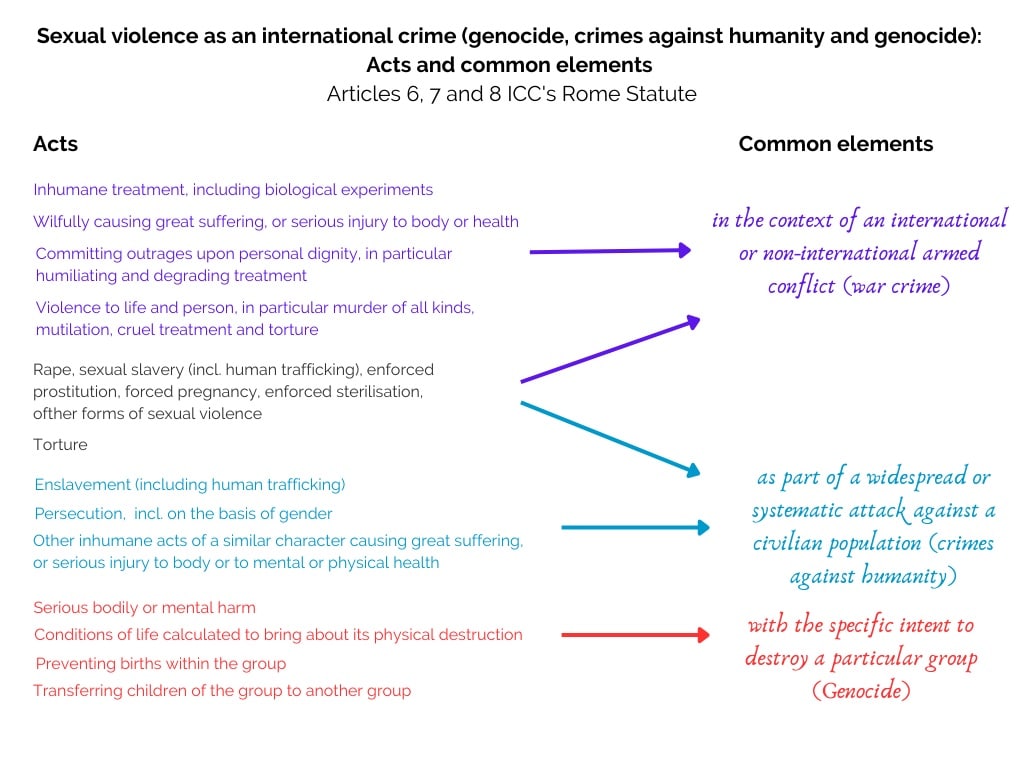
CRSV crimes can constitute international crimes (or so-called atrocity crimes) – such as genocide, crimes against humanity and war crimes – when certain conditions are fulfilled. These crimes are laid down in international instruments, such as the Genocide Convention (for genocide) and the four Geneva Conventions and Additional Protocols (for war crimes). As such, Member States have the duty to protect against these crimes, but also to investigate and prosecute these crimes when they have occurred. Although a Crimes against Humanity Convention as such does not exist yet, developments are on the way to make this possible as well.
In addition, these crimes are at the core of international criminal tribunals and courts, such as the permanent International Criminal Court (ICC), where the crimes can be found in its Statute (Articles 6, 7 and 8), Elements of Crimes document and its subsequent interpretation in case law. The crimes consist out of an act (e.g. rape) and common elements (e.g. a widespread or systematic attack against a civilian population in the case of crimes against humanity).
For example, the elements of the crime of rape (as a crime against humanity) can be found in the Elements of Crimes and read as follows:
Article 7 (1) (g)-1
Crime against humanity of rape
- The perpetrator invaded 15 the body of a person by conduct resulting in penetration, however slight, of any part of the body of the victim or of the perpetrator with a sexual organ, or of the anal or genital opening of the victim with any object or any other part of the body.
- The invasion was committed by force, or by threat of force or coercion, such as that caused by fear of violence, duress, detention, psychological oppression or abuse of power, against such person or another person, or by taking advantage of a coercive environment, or the invasion was committed against a person incapable of giving genuine consent. 16
- The conduct was committed as part of a widespread or systematic attack directed against a civilian population.
- The perpetrator knew that the conduct was part of or intended the conduct to be part of a widespread or systematic attack directed against a civilian population.
15 The concept of “invasion” is intended to be broad enough to be gender-neutral.
16 It is understood that a person may be incapable of giving genuine consent if affected by natural, induced or age-related incapacity. This footnote also applies to the corresponding elements of article 7 (1) (g)-3, 5 and 6.
To understand fully what the definition of rape as a crime against humanity entails, the jurisprudence on this crime needs to be taken into account as well.
CRSV is, more and more, also prosecuted in national courts, such as military tribunals, hybrid tribunals and purely domestic specialized chambers. However, there is generally a lack of similar national definitions of these crimes. Given that it is the ICC’s goal, from the perspective of the complementarity principle, to have the crimes prosecuted in the national courts, it is imperative for states parties to the Rome Statute to implement the Court’s provisions on CRSV in their national legislation. This enables the advanced ICC legislation on CRSV to have the intended global effect, beyond the Court’s immediate jurisdiction. However, since implementing legislation is not mandatory for states parties, let alone non-states parties, few have actually enacted implementing legislation and even fewer have enacted legislation in conformity with the Rome Statute (some states enact legislation copying verbatim the CRSV crimes; some states only partly copy the crimes; while other states do not include CRSV crimes at all). States which are not parties to the Rome Statute should also incorporate serious international crimes in their national legislation as a matter of customary international law, but again such laws are the exception.

Sources
- Elisabeth Jean Wood, Conflict-Related Sexual Violence and the Policy Implications of Recent Research”, International Review of the Red Cross, Vol. 96, issue 894 (2014), 457-478.
- Women’s Initiative for Gender Justice, The Hague Principles on Sexual Violence, 2020.
- International Federation for Human Rights (FIDH), Sexual and Gender-based Violence: A Glossary from A to Z, 2020.
- Kim Thuy Seelinger, “Close to Home: A Short History, and Rough Typology, of National Courts Prosecuting Wartime Sexual Violence” Journal of International Criminal Justice, Vol.18, Issue 2 (2020), 219-242.
- Kim Thuy Seelinger, “Domestic Accountability for Sexual Violence: The Potential of Specialized Units in Kenya, Liberia, Sierra Leone and Uganda”, International Review of the Red Cross, Vol. 96, Issue 894 (2014), 539-564.
- Women’s Initiatives for Gender Justice, Complementarity Project (2007).
- Database Sexual Crimes in Conflict (Nuremberg International Principles Academy).
Assignment 1
Terminology used to describe CRSV
1) Explain in your own words what the differences are between the different terminology used to describe conflict-related sexual violence, such as CRSV, SViC, SGBV/GBV, and SVMW.
2) There is concern with some around the utilization of the SVMW terminology. Can you explain what this concern could be?
3) There has been criticism that CRSV initiatives have too narrow a focus as it neglects other forms of GBV, such as Intimate Partner Violence (IPV). Can you explain what this criticism is about and whether you agree with this criticism?
Assignment 2
CRSV as international crimes
1) Look up the prohibition of CRSV as an international crime in your own country and that of another country. To what extent are the CRSV crimes in conformity with the CRSV crimes laid down in the ICC’s Rome Statute? Is this is a positive or negative development?